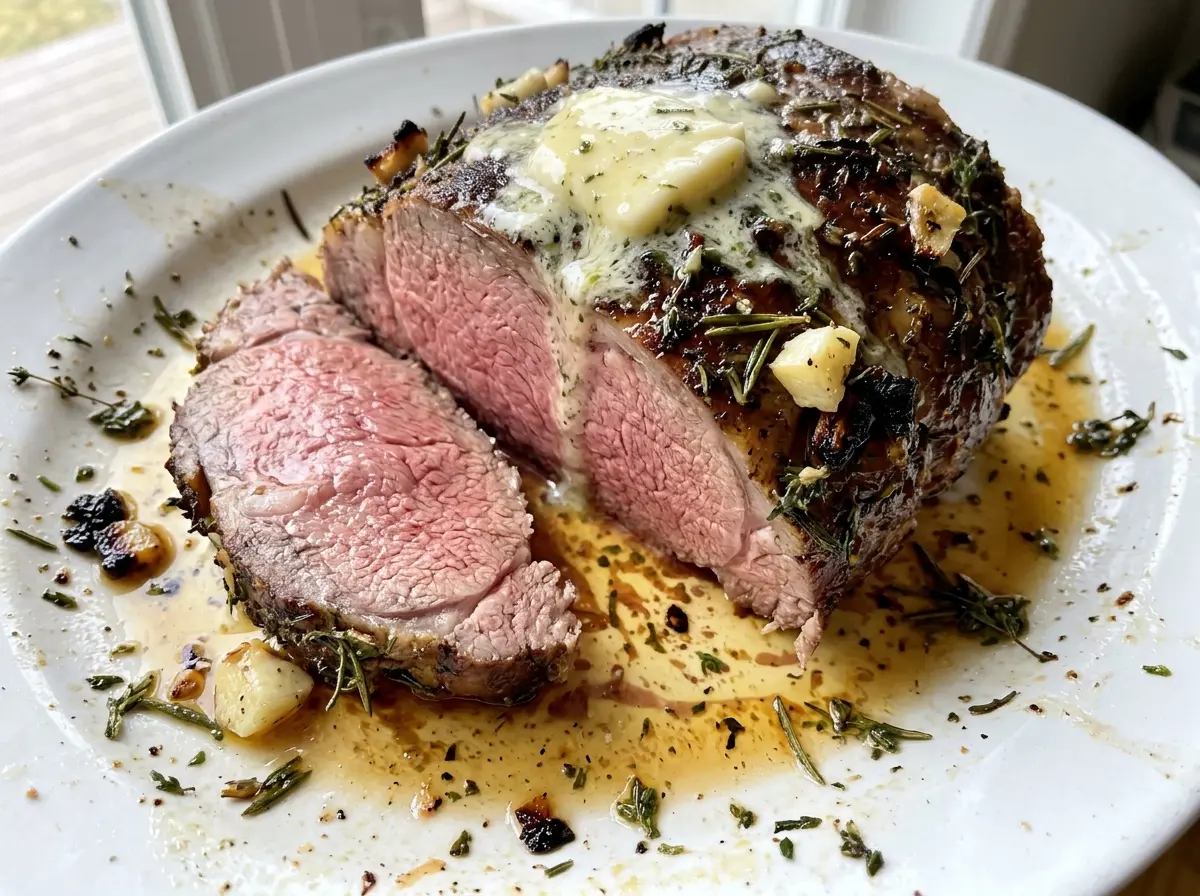
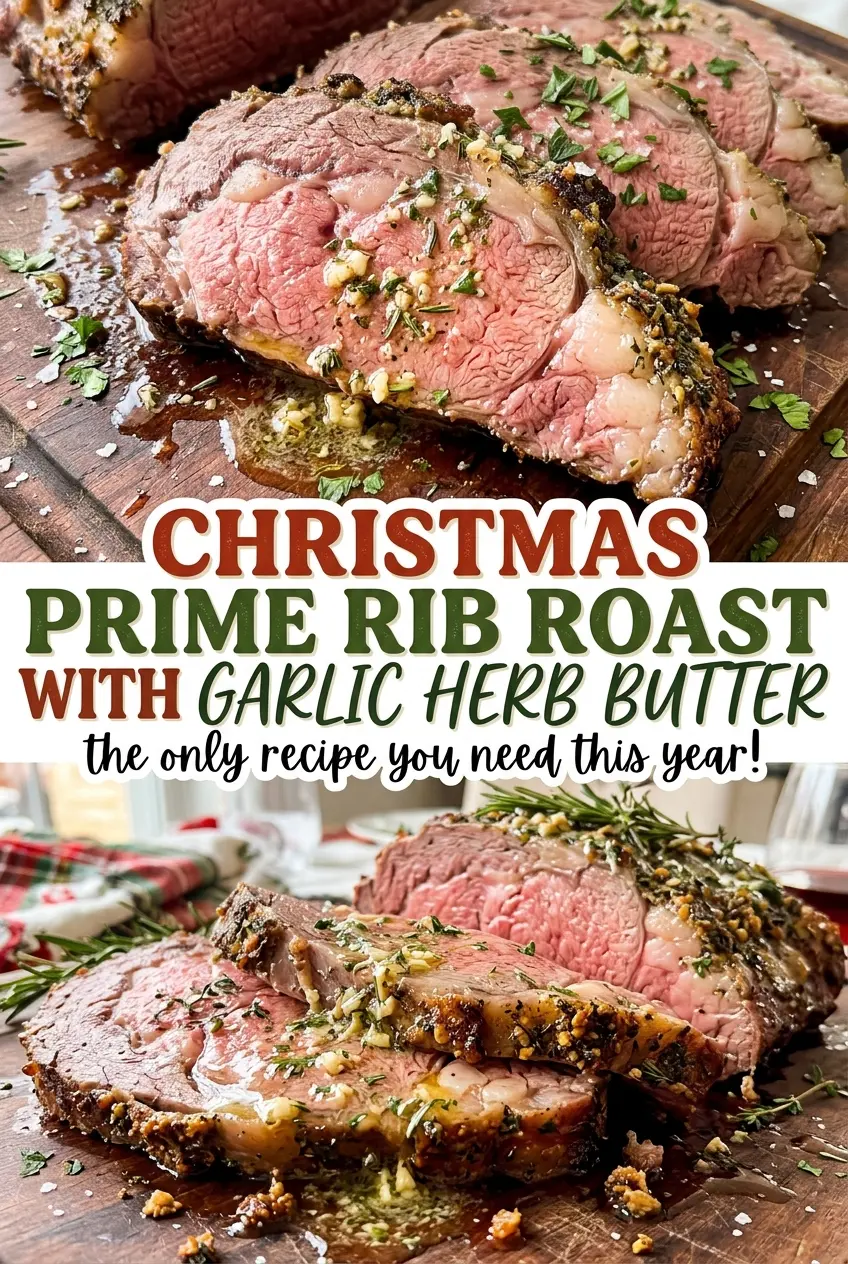
The buttered top starts to darken while the roast is still settling into its long stretch in the oven, and that’s exactly the contrast I want: a browned outside with tender slices beneath. This Christmas Prime Rib Roast with Garlic Herb Butter serves eight, and the seasoning is mixed right in a bowl before it’s spread over the meat. There’s no separate sauce to fuss over while the roast cooks.
I use a 5-pound bone-in roast with the chine bone removed and the roast tied. That shape gives you a steady base on the rack and keeps the roast together through cooking. The fresh rosemary and thyme bring a woodsy aroma to the butter, while minced garlic gets worked across the top and sides. Once the roast has rested, the twine comes off and it’s ready to carve into slices with a fragrant, buttery crust.
Kitchen Note
When you check the roast, place the thermometer in the thickest part and keep the tip clear of the bone. A probe resting against bone can give you a misleading reading, so shift it slightly if you’re unsure.
Save this Christmas prime rib roast for a centerpiece with a garlic, rosemary, and thyme butter crust.
Why the bones and twine matter before the roast even goes in
A tied, bone-in roast isn’t just a traditional presentation. The bones give the roast a natural underside, while the twine helps hold the meat in a compact shape. That matters because an uneven, loose roast can cook less uniformly: a thinner section reaches its target sooner than a thick one, leaving you with a mix of doneness across the slices.
For this version, the chine bone is removed and the roast is tied, but the rib bones stay attached. Keep that structure intact through roasting rather than cutting the twine or separating the bones early. Set the roast bone-side down on the rack so it sits securely. When it’s time to serve, remove the twine after the rest and carve the roast into slices. Those small choices help the roast hold together from oven to cutting board without adding extra steps.
What the butter, fresh herbs, and roast each bring
- Bone-in prime rib — Choose a roast with the chine bone removed and ask for it to be tied if that service is available. The bone-in shape is part of how this roast is prepared and positioned; a boneless cut won’t match the same cooking behavior or timing.
- Unsalted butter — Softened butter blends easily with the garlic and herbs and spreads over the roast without needing a separate coating. Unsalted butter also lets the kosher salt season the meat without the extra, variable saltiness of salted butter.
- Fresh rosemary and thyme — Their chopped leaves distribute through the butter and perfume the outside as it roasts. Fresh herbs give this butter its intended texture and aroma; dried herbs won’t give the same result in this preparation.
- Fresh garlic — Minced cloves spread through the butter and cling to the surface. Mince them finely so larger pieces don’t interrupt an even coating.
- Kosher salt and black pepper — These season the roast’s surface, where the herb butter carries them across the meat. Use kosher salt for the measured seasoning rather than swapping in fine table salt without adjusting it.
Getting the herb butter onto the roast before the oven
Mix a spreadable garlic herb butter
Stir the softened butter, minced garlic, chopped rosemary, chopped thyme, kosher salt, and black pepper together in a small bowl. Work until the herbs and seasoning look distributed rather than sitting in separate patches. If the butter is too firm to stir smoothly, it won’t spread as evenly over the roast. Softened butter should be pliable, not melted.
Dry the surface and coat the top and sides
Pat the roast dry with paper towels before adding the butter. A damp surface makes the coating harder to spread evenly, so take a moment to blot the top and sides. Use your hands or a spoon to cover those areas with the garlic herb butter. Check the sides too; they’re easy to miss when you focus on the broad top.
Start hot, then finish at a lower oven temperature
Set a rack inside a 16×13-inch roasting pan and preheat the oven to 450°F. Put the roast bone-side down on the rack and roast it at that temperature for 20 minutes. Reduce the oven to 325°F and continue roasting for 1 to 2 hours, until a thermometer inserted in the thickest part without touching bone reads 145°F. Use the thermometer reading to judge doneness rather than relying on the clock alone.
Rest before removing the twine and carving
Move the roast to a cutting board and tent it loosely with foil. Let it rest for at least 20 minutes before carving; cutting too soon lets juices run onto the board instead of staying with the slices. After the rest, cut away the twine. Carve the roast into slices and serve while the herb-buttered exterior is still fragrant.
Three ways to change the herb butter without changing the roast
A rosemary-forward crust
Leave out the thyme and keep the rosemary, garlic, butter, salt, and pepper. The outside will lean more piney and aromatic, with fewer distinct herb notes competing in each slice.
A thyme-led version
Use the listed thyme and leave out the rosemary. Its lighter, earthier herbal note makes a subtler crust while keeping the garlic and butter at the center.
A dairy-free herb coating
Replace the unsalted butter with an equal amount of firm, unsalted plant-based butter. Choose one that softens to a spreadable consistency; the herbs will still coat the roast, though the crust may taste less rich and brown a little differently.
Storage and Reheating
- Refrigerator: Refrigerate leftover slices promptly and use within 3 to 4 days. The chilled butter will firm up, and the beef will be less tender straight from the refrigerator.
- Freezer: Freeze slices in an airtight freezer-safe container or wrap them tightly, separating portions so you can thaw only what you need. For best quality, use within 2 to 3 months and thaw in the refrigerator.
- Reheating: Reheat slices covered in the microwave in short bursts until they reach 165°F. Long, uncovered heating dries the cut edges, so stop once the slices are hot.
Questions that come up when roasting prime rib
Christmas Prime Rib Roast with Garlic Herb Butter
Ingredients
Equipment
Method
- Preheat the oven to 450°F and set a rack inside a 16x13-inch roasting pan.
- Stir together the butter, garlic, rosemary, thyme, salt, and pepper in a small bowl.
- Pat the roast dry with paper towels and spread the garlic herb butter evenly over the top and sides.
- Set the roast bone-side down on the rack and roast at 450°F for 20 minutes, then reduce the oven to 325°F and roast for 1 to 2 hours, until a thermometer inserted into the thickest part without touching bone reads 145°F.
- Transfer the roast to a cutting board, tent loosely with foil, and rest for at least 20 minutes before carving.
- Cut away the twine and carve the roast into slices.