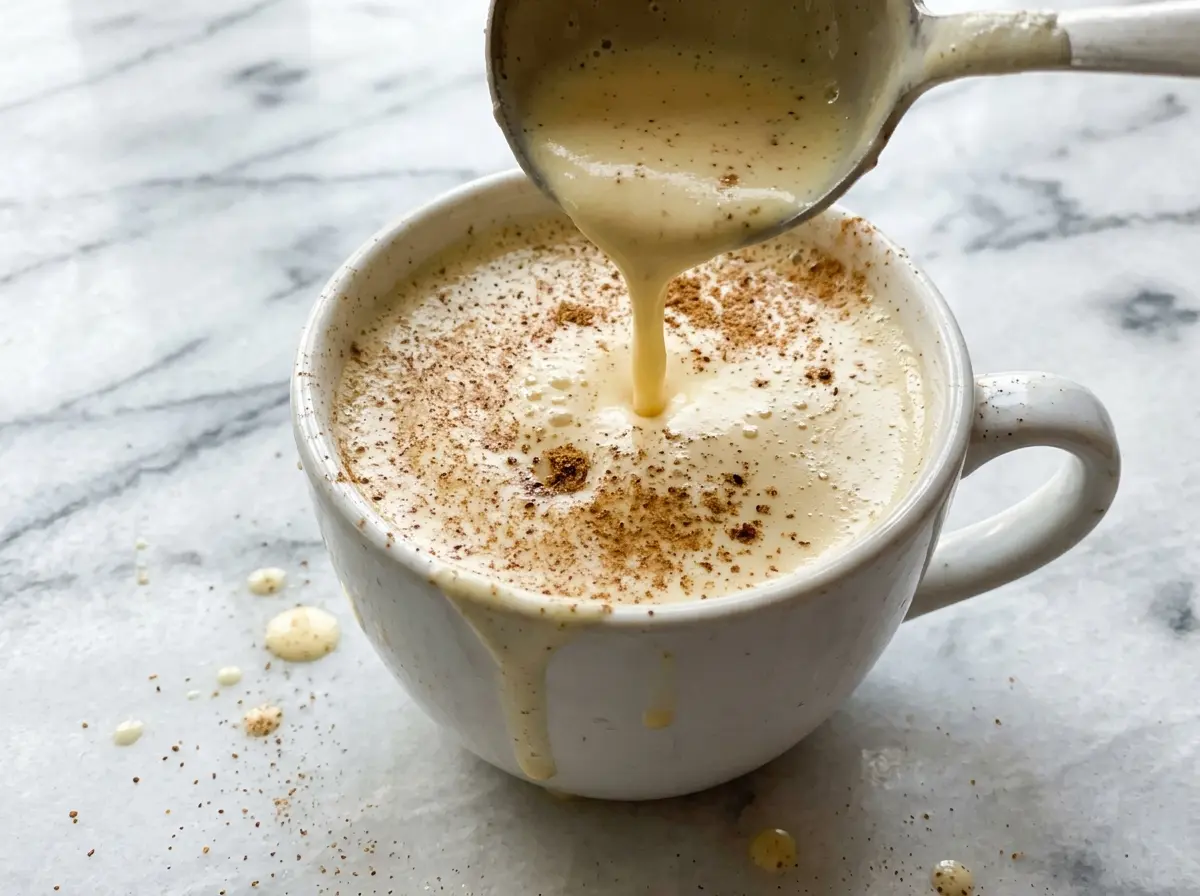
The milk begins to steam, and tiny bubbles gather around the edge of the saucepan. That’s the moment to slow down, not crank up the heat. I learned that a smooth custard depends on keeping the dairy hot but never boiling, especially once the egg yolks go back into the pan. Classic homemade eggnog gets its silky texture from that gentle cooking, not from a long simmer.
I whisk a little hot milk into the yolks first, then bring that warmed mixture back to the saucepan. It sounds fussy, but it’s an easy way to keep the eggs from tightening into little curds. Once the custard coats the back of a spoon, it’s ready for the strainer and a proper chill. The finished eggnog is creamy, softly spiced, and easy to pour into a glass.
Kitchen Note
Set the fine-mesh strainer over a clean bowl before you start cooking the custard. Once it’s off the heat, you’ll want to strain it without stopping to find your tools or clear a spot on the counter.
Save this classic homemade eggnog for a creamy, nutmeg-scented holiday pour—with bourbon, dark rum, or no alcohol at all.
Why eggnog turns grainy when the custard gets too hot
Egg yolks thicken as they cook, but they don’t need to reach a boil to do their job. At a controlled temperature, the yolks give the dairy enough body to coat a spoon while keeping the texture pourable. Push the heat too far and the proteins tighten quickly; instead of a smooth custard, you can wind up with tiny cooked bits that feel sandy on the tongue.
Tempering helps prevent that sudden change. Whisking hot dairy into the yolks gradually warms them before they return to the saucepan, so the temperature rises more evenly. Then steady stirring keeps the custard moving across the bottom of the pan, where it would otherwise catch first. The target is a lightly thickened custard, not pudding. That balance is what gives homemade eggnog its creamy feel without making it heavy.
The yolks, cream, and nutmeg behind this eggnog’s texture

- Egg yolks — They thicken the dairy into a custard and give the drink its smooth, rich body. Use large yolks as listed; whole eggs add whites that change the texture and can make the mixture foamy rather than silky.
- Whole milk and heavy cream — Whole milk keeps the eggnog pourable, while heavy cream adds a fuller, rounder texture. Fresh dairy matters more than a specialty brand here. For a dairy-free adaptation, see the variation below rather than swapping in a thinner milk on its own.
- Granulated sugar — Sugar sweetens the custard and dissolves readily as you whisk it with the yolks. It also gives the vanilla and nutmeg room to come through without adding a competing flavor.
- Ground nutmeg — Nutmeg brings the warm, familiar aroma that makes this taste like eggnog. Check that your jar still smells fragrant; stale ground spice can make the whole batch taste flat.
- Vanilla extract — Vanilla rounds out the dairy and spice. A good-quality extract has a cleaner aroma, but any vanilla extract you enjoy using will work.
- Bourbon or dark rum — Either is optional, and both add warmth to the finished drink. Bourbon tends to taste more oaky, while dark rum brings a sweeter, molasses-like note; choose the one you prefer or leave it out.
- Kosher salt — A small pinch balances the sweetness and keeps the custard from tasting flat. Keep the listed salt type and amount for the intended seasoning.
Building a smooth custard without rushing the heat
Whisking the yolks before the dairy is ready
In a medium heatproof bowl, whisk the egg yolks with the sugar and kosher salt until the mixture looks smooth and slightly thickened. Break up any streaks of yolk before you start adding hot liquid. A stable, evenly mixed base makes it easier to temper without chasing dry sugar or yolk clumps around the bowl.
Warming the milk, cream, and nutmeg
Combine the whole milk, heavy cream, and ground nutmeg in a 3-quart saucepan over medium heat. After about 4–6 minutes, the mixture should be steaming, with small bubbles around the edges. Don’t let it boil; a rolling boil is hotter than this custard needs and can make the next step harder to control.
Tempering and thickening the egg yolks
Slowly whisk about 1 cup of the hot milk mixture into the yolks, then gradually whisk the warmed yolk mixture back into the saucepan. Lower the heat to medium-low and stir constantly for about 5–8 minutes. The custard is ready when it reaches 160°F and lightly coats the back of a spoon; keep stirring and don’t let it boil.
Straining, flavoring, and chilling
Pour the custard through a fine-mesh strainer into a clean bowl, then stir in the vanilla and bourbon or dark rum if you’re using it. Set the bowl in an ice bath and stir until cool, about 10–15 minutes. Cover the bowl and refrigerate until thoroughly chilled, at least 4 hours; the eggnog is at its best when cold.
Bourbon, rum, or no alcohol: ways to make this eggnog yours
Choose bourbon for oak or dark rum for sweetness
Both options work in the finished custard. Bourbon gives the drink an oaky edge, while dark rum leans sweeter and rounder. Add either after straining so you can adjust the flavor without changing how the custard cooks.
Leave out the alcohol for a family-friendly pour
Skip the bourbon or rum and follow the same custard method. The result stays creamy and warmly spiced, with the vanilla and nutmeg coming through more clearly.
Make a dairy-free version with oat milk and coconut milk
Replace the whole milk with the same amount of unsweetened oat milk, and replace the heavy cream with an equal amount of full-fat canned coconut milk. The yolks still thicken the mixture, though the coconut gives the finished eggnog a noticeable flavor that isn’t part of the classic dairy version.
Storage and Reheating
- Refrigerator: Keep the covered eggnog at 40°F or colder and use it within 3 days. It may thicken a little more as it chills.
- Freezer: I don’t recommend freezing it; the egg custard can separate and turn grainy after thawing.
- Reheating: Serve it cold rather than reheating it. If it separates slightly in the refrigerator, whisk gently before pouring; extra heat can make the custard curdle.
Questions that come up with homemade eggnog
Classic Homemade Eggnog
Ingredients
Equipment
Method
- In a medium heatproof bowl, whisk the egg yolks, sugar, and salt until smooth and slightly thickened.
- In a 3-quart saucepan, heat the milk, heavy cream, and nutmeg over medium heat until steaming with small bubbles around the edges, about 4–6 minutes; do not let it boil.
- Slowly whisk about 1 cup of the hot milk mixture into the yolk mixture.
- Gradually whisk the tempered yolk mixture back into the saucepan.
- Cook over medium-low heat, stirring constantly, until the custard reaches 160°F and lightly coats the back of a spoon, about 5–8 minutes; do not let it boil.
- Strain the custard through a fine-mesh strainer into a clean bowl.
- Stir in the vanilla and bourbon or rum, if using.
- Set the bowl in an ice bath and stir until cool, about 10–15 minutes.
- Cover and refrigerate until thoroughly chilled, at least 4 hours.