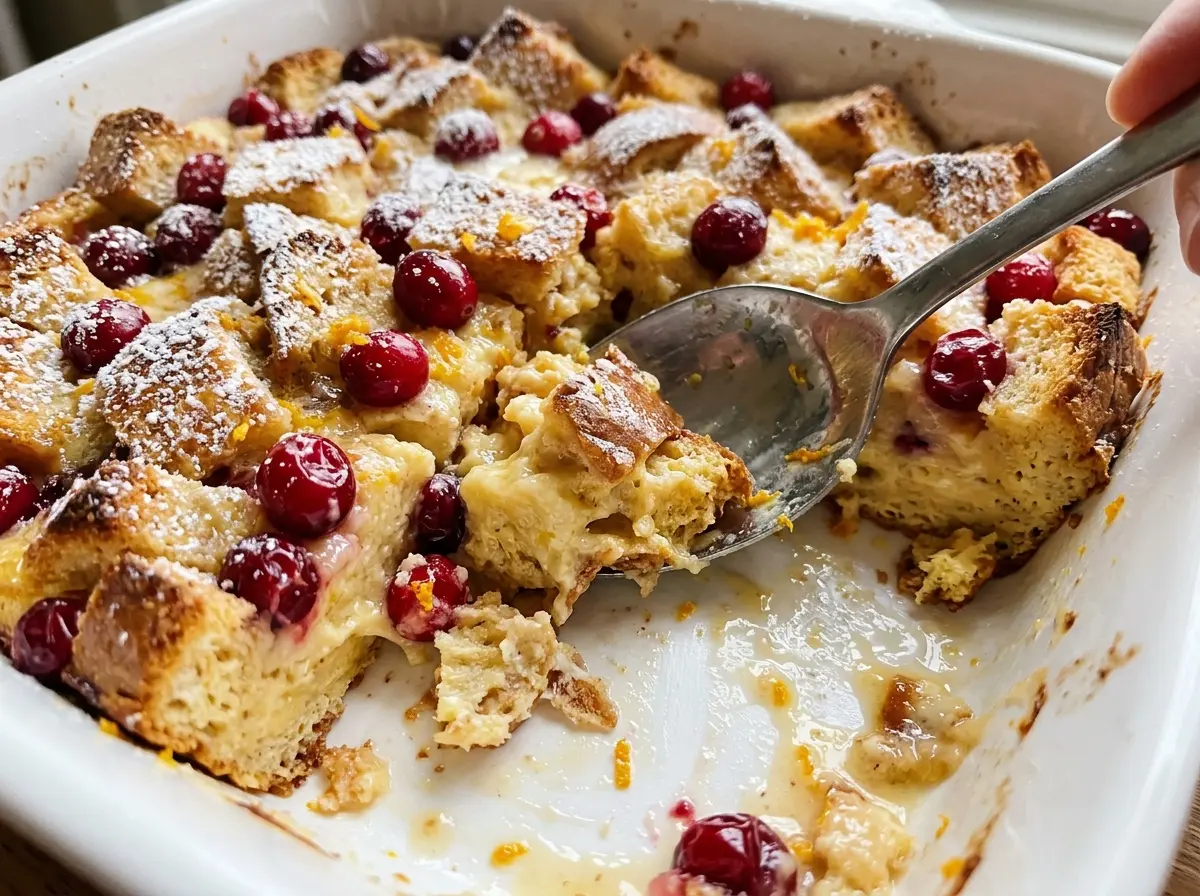
When the foil comes off, the cranberries have softened and the bread has puffed into a golden top with a custardy middle. That contrast is what makes this Cranberry Orange French Toast Bake worth planning ahead for: tart berries cut through the rich egg-and-milk base, while orange gives each bite a bright, fragrant note.
I like this bake because the hands-on work is brief, then the refrigerator does the soaking. Cutting the French bread into even cubes helps the custard reach the middle of the dish, and spreading the cranberries over the bread keeps their tartness in more than one bite. After a short rest from the oven, each portion is tender without falling apart, with cranberry pockets tucked into the orange-scented bread.
Kitchen Note
When I use frozen cranberries, I scatter them into the dish straight from the freezer. Thawing first leaves red juice on the bread before the custard has a chance to soak in.
Save this Cranberry Orange French Toast Bake for its tart berry pockets and soft, orange-scented center.
Why Fresh or Frozen Cranberries Work Better Than Dried Here
Fresh and frozen cranberries bring a sharp, juicy contrast to the rich custard. As the bake cooks, the berries soften and their tartness balances the sweet bread and orange-scented egg mixture. They also keep distinct little bursts of fruit in each serving instead of disappearing into the custard.
Dried cranberries are a different ingredient in this dish. They’re sweeter and chewier, and they don’t bring the same juicy texture as fresh or frozen fruit. You could put them in bread pudding, but they won’t give this bake the same tart balance. I stick with fresh or frozen cranberries here, spread evenly over the bread so you don’t end up with one berry-heavy corner and another without any.
The Ingredients That Give This Bake Its Structure and Orange Aroma

- French bread — A loaf with a sturdy crumb holds its shape while soaking, so the middle turns tender instead of dissolving into a soft paste. A basic bakery loaf is fine; what matters most is cutting the cubes evenly.
- Eggs and whole milk — The eggs set the custard, and whole milk gives it a smooth, full texture. I wouldn’t replace the eggs with a liquid substitute; they’re what help the baked portions hold together.
- Orange juice and zest — The juice brings citrus flavor into the custard, while finely grated zest adds a fragrant orange aroma. Bottled orange juice works; take a moment to grate the zest finely so there aren’t large bitter pieces in the bread.
- Vanilla and cinnamon — These warm the custard without hiding the citrus. Standard vanilla extract and ground cinnamon are all you need; there’s no benefit to buying a specialty version for this bake.
- Butter — Softened butter coats the baking dish and helps prevent the soaked bread from sticking at the edges. Spread it into the corners as well as across the bottom.
How to Assemble and Bake the Custard-Soaked Bread
Layer the Bread and Cranberries
Grease a 9×13-inch baking dish with the softened butter. Spread the 1-inch bread cubes across the dish, then scatter the cranberries evenly over them. An even layer gives each portion a mix of bread and berries.
Whisk and Pour the Orange Custard
In a large bowl, whisk the eggs, whole milk, orange juice, sugar, orange zest, vanilla, cinnamon, and salt until combined. Pour the mixture evenly over the bread and berries rather than in one spot. Gently press the bread down so the cubes soak up the custard; press lightly, not hard enough to crush them.
Give the Bread Time to Soak
Cover the dish and refrigerate it for at least 4 hours and up to 12 hours. This gives the custard time to work into the bread instead of leaving the center dry. Before baking, let the dish stand at room temperature for 30 minutes while the oven heats to 350°F.
Bake Covered, Then Uncover
Keep the dish covered with foil for the first 35 minutes in the oven. Remove the foil and bake for another 20 to 25 minutes, until the top is golden and the center is set. The middle should reach 160°F; check it there rather than relying on color alone.
Rest Before Serving
Take the dish out of the oven and let it rest for 10 minutes before serving. The custard settles during this pause, making portions easier to lift without squeezing out the soft center. Serve while the top is still golden and the cranberry pockets are warm.
Three Ways to Adapt the Bread and Fruit
Use Challah for a Richer, Softer Bake
Swap in a 16-ounce loaf of challah cut into 1-inch cubes. Its egg-enriched crumb makes the casserole a little richer and more tender than French bread, so press the cubes gently when you add the custard.
Trade the Cranberries for Blueberries
Use an equal volume of fresh or frozen blueberries in place of the cranberries. The result is milder and less tart, with softer, sweeter fruit pockets; the bread and custard method stays the same.
Make It Gluten-Free
Use a sturdy gluten-free French-style loaf in place of the French bread, cut into the same size cubes. The texture can be a little more delicate, so press the bread into the custard gently rather than stirring it around.
Storage and Reheating
- Refrigerator: Store covered or in an airtight container for 3 to 4 days. The bread softens as it sits, but the portions are still good warmed through.
- Freezer: Freeze cooled portions in an airtight freezer-safe container for up to 2 months. Thaw overnight in the refrigerator; the bread may be softer after thawing.
- Reheating: Cover a portion and microwave it in short bursts until hot throughout. Leaving it uncovered for too long can dry the edges before the center is warm.
Questions That Come Up Before the First Slice
Cranberry Orange French Toast Bake
Ingredients
Equipment
Method
- Grease a 9x13-inch baking dish with the butter, then spread the bread cubes in the dish and scatter the cranberries evenly over them.
- Whisk the eggs, milk, orange juice, sugar, orange zest, vanilla, cinnamon, and salt in a large bowl until combined, then pour the mixture evenly over the bread and gently press the bread down to soak.
- Cover the dish and refrigerate for at least 4 hours or up to 12 hours.
- Let the dish stand at room temperature for 30 minutes while the oven heats to 350°F.
- Bake covered with foil for 35 minutes, then uncover and bake for 20 to 25 minutes, until the center is set, the top is golden, and the center reaches 160°F.
- Let the bake rest for 10 minutes before serving.