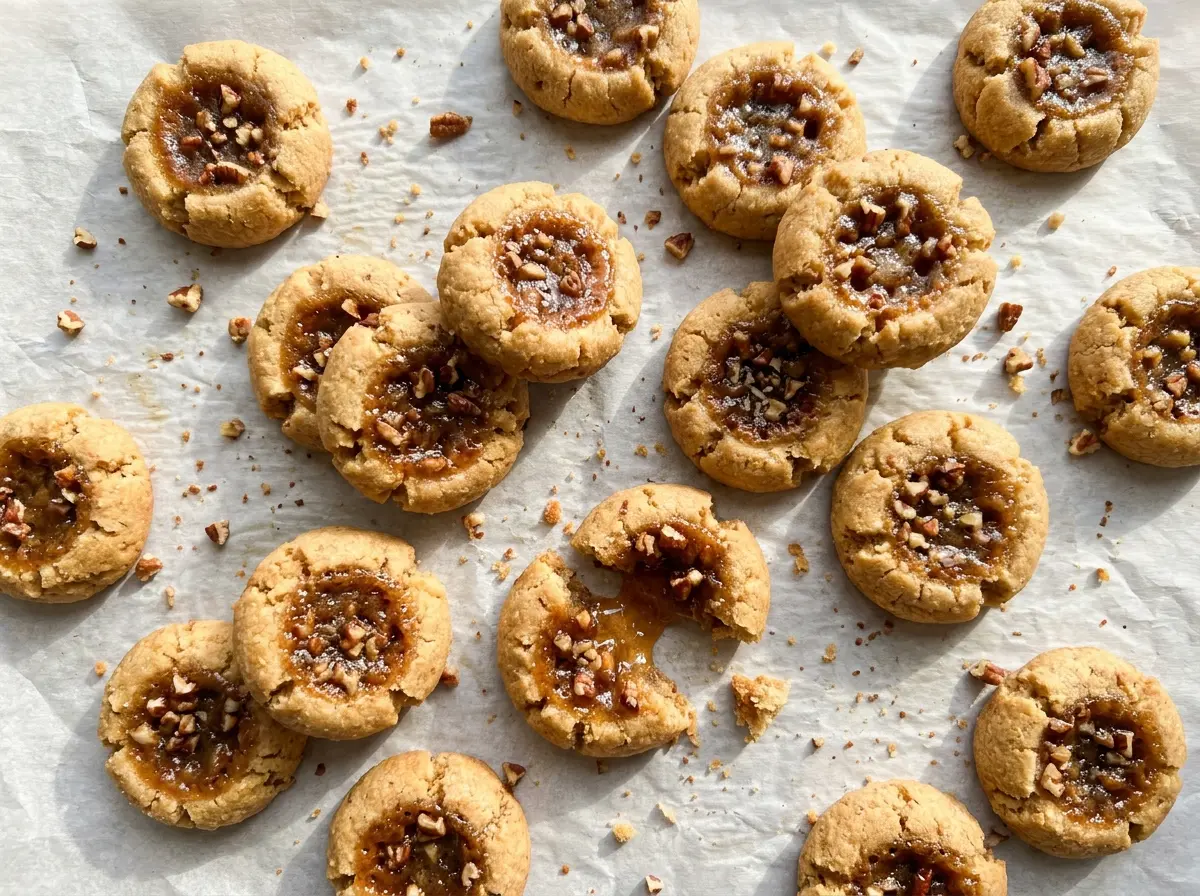
When the first tray comes out, the little wells look shallower than they did before baking. The cookies have puffed just enough to soften their shape, and the edges are only beginning to turn golden. These pecan pie thumbprint cookies get their neat centers from a careful second press, then a spoonful of sweet pecan filling turns each one into a small, buttery bite.
I like the contrast between the plain, tender cookie and the filling, where light corn syrup and brown sugar bring the familiar sticky sweetness of pecan pie. The cookie dough stays simple and lightly sweet, so the pecans have room to come through instead of getting lost in a sugary base. Once cooled, the cookies hold together well, with a delicate crumb around the set, nut-studded center.
Kitchen Note
Give the covered dough its full 30 minutes in the refrigerator before shaping. It firms up enough to roll cleanly, and the balls are easier to press without sticking to your hands.
Save these pecan pie thumbprint cookies for a bake when you want buttery edges and a sweet, nut-filled center in every bite.
Why the Pecan Filling Goes Into a Baked Cookie Shell
These cookies have two different textures to get right: a tender cookie that can hold its shape, and a soft filling that sets without turning the whole cookie soggy. Baking the dough first gives the edges time to firm before the egg-based pecan mixture goes in. If you put the filling into raw dough, the cookie would have to finish baking while the filling cooks through, making it harder to get both textures where they should be.
The first bake also gives you a useful chance to restore each well. The dough rises slightly as it bakes, so the initial indentation may not be deep enough to hold the filling neatly. Pressing it again with the back of a teaspoon creates room for the filling without asking you to overfill the cookies. Keep the filling in the center of each well; a little space around it helps the cookie stay recognizable as a thumbprint instead of spreading into one flat layer.
There’s a useful flavor balance here, too. The cookie is buttery and restrained, while the filling brings the brown sugar, corn syrup, and pecans. That contrast keeps each bite from tasting like a mouthful of filling alone.
What Gives the Cookie and Filling Their Different Textures

- Unsalted butter gives the cookie its rich, tender base, while using unsalted butter lets the fine salt stay in proportion. It doesn’t need to be a specialty brand; choose butter you like the taste of, and soften it before mixing. There isn’t a direct swap that keeps the same buttery crumb.
- All-purpose flour and granulated sugar make a simple dough that supports the filling rather than competing with it. Regular all-purpose flour works well here, and mixing it on low only until the dough comes together helps keep the cookies tender. For a gluten-free version, use a cup-for-cup gluten-free baking blend in place of the all-purpose flour.
- Egg, light corn syrup, and light brown sugar make a cohesive filling that sets as it bakes. The egg provides structure, the syrup gives the center its sticky pecan-pie character, and brown sugar adds a deeper sweetness. Use light corn syrup for the intended flavor; there’s no need to buy a premium brand.
- Vanilla and pecans round out the filling. Fresh-tasting pecans matter more than an expensive label, since stale nuts can bring an unpleasant bitter note. Chop them finely so the filling is easy to spoon into the small wells and each cookie gets a little crunch.
How to Bake the Shells Before Filling Them
Mix a Soft, Tender Dough
Heat the oven to 350°F and line two 18×13-inch baking sheets with parchment paper. Beat the softened butter and granulated sugar in a large bowl until smooth, about 2 minutes. Add the flour and fine salt, mixing on low just until a soft dough forms. Stop once the flour disappears; the dough doesn’t need prolonged mixing.
Chill, Portion, and Press
Cover the dough and refrigerate it for 30 minutes. Scoop it into 24 portions of about 1 1/2 tablespoons each, then roll each portion into a ball. Set the balls 2 inches apart on the prepared baking sheets so they have room as they bake. Press a deep indentation into the center of every ball, keeping the cookie intact around the bottom of the well.
Bake and Deepen the Wells
Bake the cookies for 12–14 minutes, until they’re set and the edges are just beginning to turn golden. Don’t wait for the tops to brown deeply; these are meant to stay pale and tender. Take care when working with the hot sheets, then use the back of a teaspoon to deepen each indentation. The wells should be wide and deep enough to hold the filling without spilling over the edges.
Fill and Bake Until Set
Whisk the egg, light corn syrup, brown sugar, and vanilla in a small bowl until combined, then stir in the finely chopped pecans. Spoon about 1 1/2 teaspoons of filling into each indentation, keeping it within the well. Bake for 8–10 minutes, until the filling is set and reaches 160°F on an instant-read thermometer. Let the cookies cool on the baking sheets for 10 minutes before moving them to a wire rack to cool completely.
Two Easy Ways to Adapt These Thumbprints
Use Walnuts in the Filling
Replace the finely chopped pecans with the same amount of finely chopped walnuts. The filling will still set, with a slightly earthier, less buttery nut flavor. Chop the walnuts small enough to fit easily into the cookie wells.
Make a Gluten-Free Batch
Replace the all-purpose flour with a cup-for-cup gluten-free baking blend, using the same amount. Choose a blend formulated to replace wheat flour in baking; the dough may feel more delicate when you roll it, so handle the balls gently as you shape them.
Storage and Reheating
- Refrigerator: Keep fully cooled cookies in an airtight container for up to 4 days. The cookie may soften slightly as it sits beside the filling.
- Freezer: Freeze cooled cookies in a single layer until firm, then transfer them to an airtight freezer container for up to 2 months. Thaw in the refrigerator before serving.
- Reheating: Warm cookies in a 300°F oven for about 5 minutes, just until the centers are no longer cold. Avoid the microwave, which can soften the cookie unevenly and make the filling overly hot.
Questions That Come Up While Baking These Cookies
Pecan Pie Thumbprint Cookies
Ingredients
Equipment
Method
- Heat the oven to 350°F.
- Line two 18x13-inch baking sheets with parchment paper.
- In a large bowl, beat the butter and granulated sugar until smooth, about 2 minutes.
- Mix in the flour and salt on low speed just until a soft dough forms.
- Cover and refrigerate the dough for 30 minutes.
- Scoop the dough into 24 portions, about 1 1/2 tablespoons each, and roll them into balls.
- Arrange the balls 2 inches apart on the prepared sheets.
- Press a deep indentation into the center of each ball.
- Bake for 12–14 minutes, until the cookies are set and their edges are just beginning to turn golden.
- Carefully deepen the indentations with the back of a teaspoon.
- In a small bowl, whisk the egg, corn syrup, brown sugar, and vanilla until combined.
- Stir in the pecans.
- Spoon about 1 1/2 teaspoons of filling into each indentation.
- Bake for 8–10 minutes, until the filling is set and reaches 160°F when checked with an instant-read thermometer.
- Cool the cookies on the baking sheets for 10 minutes.
- Transfer them to a wire rack to cool completely.