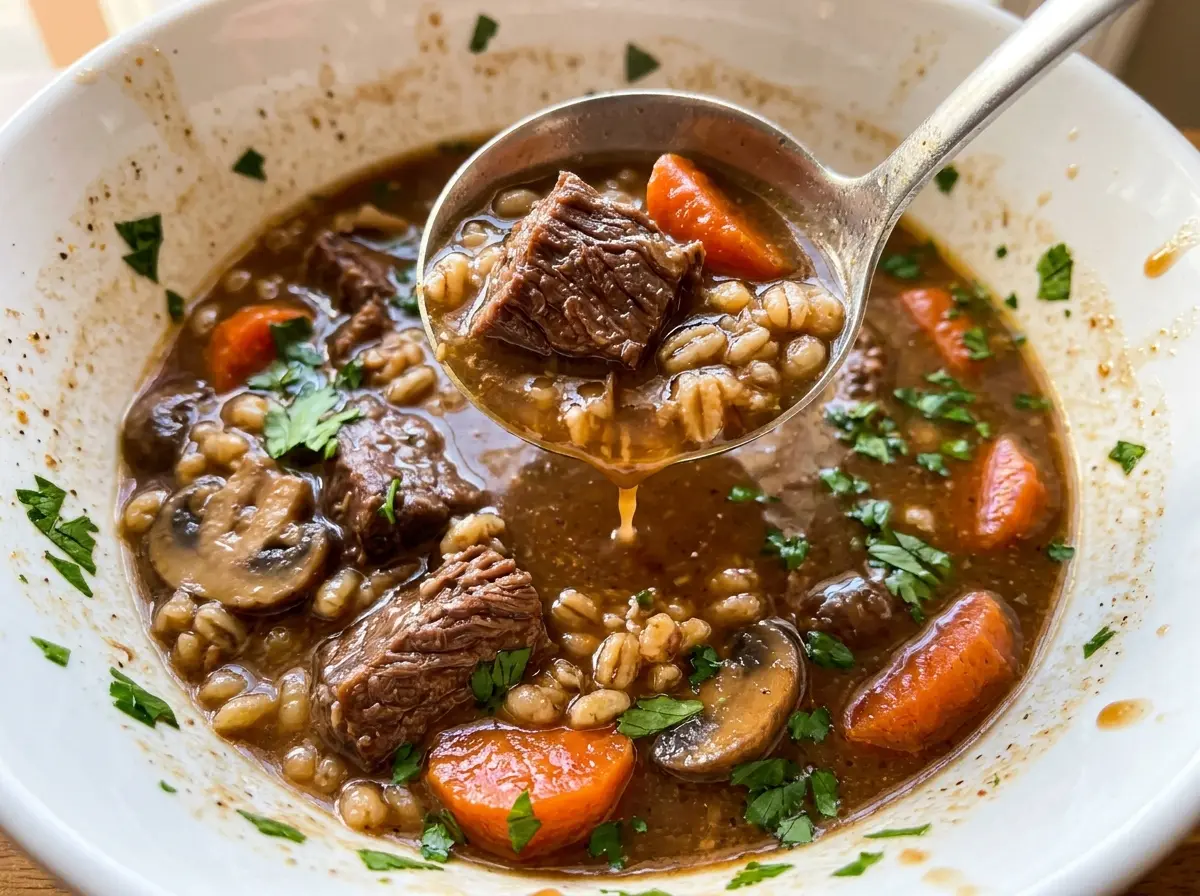
A Dutch oven starts to smell like stew long before anything goes into the broth: first the beef browns, then the mushrooms pick up color in the same pot. I used to rush past those stages and ended up with a pot that was filling but flat. Taking the time to brown each batch gives this beef and barley stew with mushrooms and carrots a deeper, savory base.
The timing is built around two very different ingredients. Beef chuck needs a long, gentle simmer to become fork-tender, while pearl barley and carrots need less time in the pot. Adding them later keeps the barley pleasantly chewy instead of swollen and soft, and leaves the carrots with enough shape to stand up to a spoon.
When it’s ready, the broth is rich without being heavy, with tender beef, earthy mushrooms, and barley tucked into every bowl. It’s the kind of stew that feels substantial but still tastes like the ingredients in it.
Kitchen Note
Shake off the loose flour before the beef goes into the pot. A thin coating helps the cubes brown, while thick patches can turn pasty once they meet the broth.
Save this beef and barley stew for a cozy dinner when you want fork-tender beef, browned mushrooms, and a hearty barley broth.
Why the Barley Goes In After the Beef, Not at the Start
Beef chuck and pearl barley need different amounts of time to become tender. Give the beef its first stretch in the broth on its own, then add the barley with the carrots and mushrooms. That order lets the beef soften before the grains take up liquid and swell.
If barley simmers for the entire time the beef needs, it can turn too soft and thicken the broth more than you want. Adding it later gives you a better chance of keeping its pleasant, slightly chewy texture. The carrots benefit from the same timing: cut into half-inch pieces, they become tender without disappearing into the stew.
This timing also gives you a useful check point. Before the barley goes in, the beef should be nearly fork-tender, not already falling apart. It will finish cooking alongside the grains and vegetables, so the final bowl has distinct pieces rather than a pot of softened bits.
What the Beef, Barley, and Mushrooms Each Bring to the Pot

- Beef chuck — Its connective tissue softens during the long simmer, giving the stew tender, substantial pieces and body in the broth. Cut the cubes evenly so they cook at a similar pace. Packaged stew meat can vary in size and cut, so trim any pieces that are much larger than the rest.
- Pearl barley — It brings a pleasantly chewy bite and thickens the broth as it cooks. Pearl barley is the right choice for this timing; hulled barley takes longer to soften, while quick-cooking barley would become tender too soon. Rinse it before it goes into the pot.
- Cremini mushrooms — Their earthy flavor deepens when their cut surfaces brown. Button mushrooms are a practical swap if that’s what your store has; halve or quarter them to keep the pieces close in size to the cremini.
- Tomato paste, thyme, and Worcestershire sauce — Together they give the broth a savory, rounded backbone without making it taste like tomato soup. Stir the tomato paste with the aromatics for its brief cook so it blends into the broth rather than sitting in a lump.
- Carrots, onion, celery, and garlic — These build the stew’s aromatic base, and the carrots add sweetness. Keep the carrots in half-inch pieces so they have time to become tender during the barley stage without losing their shape.
Build the Broth in Stages, Then Let the Barley Finish
Brown the Beef Without Crowding the Pot
Pat the beef dry, season it with the salt and pepper, then toss it with the flour and shake off the excess. Heat two tablespoons of vegetable oil in a 6-quart Dutch oven over medium-high heat. Brown the beef in batches for 3 to 4 minutes per side, moving each browned batch to a plate. If the pieces are packed tightly together, they’ll steam instead of developing a browned surface.
Brown the Mushrooms and Soften the Aromatics
Add the remaining tablespoon of oil and cook the mushrooms for 5 to 7 minutes, stirring occasionally, until browned; move them to the plate with the beef. Add the onion and celery and cook over medium heat for 5 minutes, stirring now and then. Stir in the garlic and tomato paste for 1 minute. Keep the garlic moving so it doesn’t scorch while the paste darkens slightly.
Simmer the Beef Until Nearly Tender
Pour in the beef broth and Worcestershire sauce, then stir in the thyme and bay leaf. Scrape the browned bits from the bottom of the pot as the liquid loosens them; they add depth to the broth. Return the beef and its juices, bring the pot to a boil, then cover and simmer over low heat for 1 to 1 1/4 hours. The beef should be nearly fork-tender before the barley goes in.
Finish with Barley, Carrots, and Mushrooms
Stir in the rinsed barley, carrots, and browned mushrooms. Cover and simmer over low heat for 45 to 55 minutes, stirring occasionally, until the barley is tender and the beef yields easily to a fork. If the grains still feel firm, keep the pot at a gentle simmer until they’re tender. Remove the bay leaf and let the stew stand for 10 minutes before serving.
Two Useful Ways to Adapt This Beef and Barley Stew
Make It Gluten-Free with Rice
For a gluten-free version, use rice flour in place of the all-purpose flour and long-grain white rice in place of the pearl barley. Add rinsed rice with the carrots and mushrooms once the beef is nearly fork-tender, then simmer until the rice is tender; it cooks faster than pearl barley, so check it rather than keeping the barley timing. Choose beef broth and Worcestershire sauce labeled gluten-free. The stew will have a softer grain and a less thick broth.
Leave Out the Barley for a Lower-Carb Bowl
Skip the pearl barley and add the carrots and mushrooms once the beef is nearly fork-tender. Simmer until the carrots are tender and the beef is fork-tender. Without barley, the broth will be thinner and the stew won’t have the same chewy, grain-filled texture.
Storage and Reheating
- Refrigerator: Refrigerate leftovers within 2 hours and keep them for 3 to 4 days. The barley will continue to absorb broth, so the chilled stew will be thicker.
- Freezer: Freeze in airtight containers for up to 3 months. Barley softens some after thawing, but the stew still freezes well.
- Reheating: Warm gently on the stovetop, stirring occasionally, until the stew reaches 165°F. If it has thickened, loosen it with a little beef broth; avoid a hard boil, which can make the beef and barley softer.
Questions That Come Up While the Stew Simmeres
Beef and Barley Stew with Mushrooms and Carrots
Ingredients
Equipment
Method
- Pat the beef dry, season it with the salt and pepper, then toss it with the flour and shake off excess.
- Heat 2 tablespoons of the oil in a 6-quart Dutch oven over medium-high heat. Brown the beef in batches for 3 to 4 minutes per side, transferring it to a plate as it browns.
- Add the remaining 1 tablespoon oil to the pot and cook the mushrooms for 5 to 7 minutes, stirring occasionally, until browned; transfer them to the plate with the beef.
- Add the onion and celery to the pot and cook over medium heat for 5 minutes, stirring occasionally. Add the garlic and tomato paste and cook for 1 minute, stirring.
- Pour in the beef broth and Worcestershire sauce, then stir in the thyme and bay leaf, scraping up any browned bits. Return the beef and its juices to the pot, bring to a boil, then cover and simmer over low heat for 1 to 1 1/4 hours, until the beef is nearly fork-tender.
- Stir in the barley, carrots, and mushrooms. Cover and simmer over low heat for 45 to 55 minutes, stirring occasionally, until the barley is tender and the beef is fork-tender.
- Remove the bay leaf and let the stew stand for 10 minutes before serving.