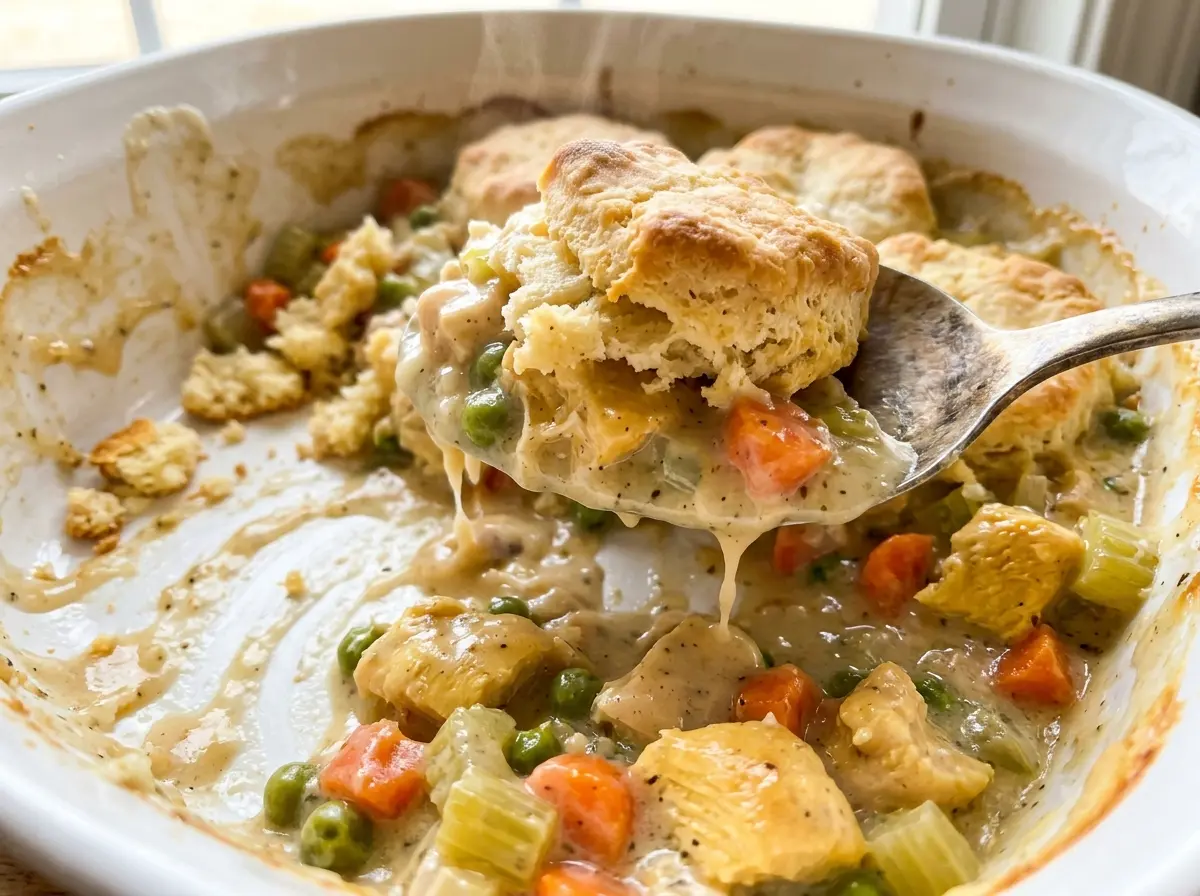
The sauce should coat the back of a spoon before it goes into the baking dish; if it still looks thin in the skillet, the casserole can turn soupy under the biscuits. I learned to give the flour time to thicken the broth and milk before stirring in the chicken and peas. That gives this chicken pot pie casserole with buttermilk biscuit topping a creamy filling that holds together when you serve it.
The biscuit dough gets a different kind of attention. Cold butter cut into pea-sized pieces and a light touch with the buttermilk keep the topping tender instead of heavy. I drop the dough over the filling in separate portions, so every serving gets a biscuit on top and the filling can bubble around the edges. After a short rest, the golden biscuits sit over a thick, savory chicken filling.
Kitchen Note
Give the casserole its full 10-minute rest before serving. The filling settles during that time, which makes it easier to spoon without losing the biscuits off the top.
Save this chicken pot pie casserole with its golden buttermilk biscuits for a cozy, make-again dinner.
Why the Filling Needs to Thicken Before the Biscuits Go On
A chicken pot pie filling can look creamy in the skillet and still bake up loose if the flour hasn’t had enough time to do its job. Here, flour first cooks briefly with the softened vegetables and butter. Then the broth and milk go in gradually, which helps the mixture turn smooth instead of leaving little floury lumps in the sauce.
That short simmer matters, too. Stir as the sauce cooks, and look for it to visibly thicken before adding the chicken and peas. The biscuits bake on top rather than being stirred into the filling, so they won’t absorb extra liquid the way a crust might. A properly thickened base gives you a creamy spoonful, not a puddle spreading across the plate.
Keep the filling’s texture in mind when you judge it in the skillet. It should be thick enough to cling lightly to the vegetables and whisk, but still easy to stir. The oven finishes the casserole; it isn’t a substitute for thickening the sauce first.
What Makes the Filling Creamy and the Biscuits Tender

- Butter and all-purpose flour — Butter gives the filling its rich base, while the flour thickens the broth and milk into a sauce. All-purpose flour is the dependable choice here because it also forms the biscuit dough; a different flour can behave differently in both jobs.
- Chicken broth and whole milk — Broth brings savory depth, and whole milk adds body to the sauce. A lower-fat milk can work, though the filling won’t taste quite as rich. Use broth you enjoy sipping; a very salty broth can make the finished filling taste saltier.
- Yellow onion, carrots, and celery — These soften together and build the base flavor before the sauce goes in. Dice them fairly evenly so they soften at a similar pace. There’s no need to seek out specialty produce; fresh, firm everyday vegetables are right for this filling.
- Cooked chicken — Chopped cooked chicken makes the filling hearty without relying on the oven to cook raw poultry during the biscuit bake. Plain cooked chicken is a good fit; heavily seasoned chicken can change the balance of the thyme and sauce.
- Frozen peas and dried thyme — Frozen peas add little sweet pops of flavor, and they can go straight into the filling without thawing. Dried thyme seasons the sauce throughout; keep it in the recipe rather than swapping in a large amount of another herb.
- Cold butter and buttermilk — The butter pieces create a tender biscuit texture, and buttermilk gives the topping its familiar tang. Keep the butter cold while cutting it into the flour. Buttermilk is worth buying for this topping; plain milk won’t provide the same acidity or flavor.
Building the Sauce and Baking Biscuits That Cook Through
Soften the Vegetables Without Browning Them
Heat the oven to 400°F and grease a 9×13-inch baking dish with nonstick cooking spray. Melt 4 tablespoons of butter in a 12-inch skillet over medium heat, then add the diced onion, carrots, and celery. Cook for 6 to 8 minutes, stirring occasionally, until the vegetables are beginning to soften. If they start browning quickly, lower the heat so they soften without taking on dark edges.
Whisk a Smooth, Thickened Filling
Stir the flour into the vegetables and butter, then cook it for 1 minute. Pour in the chicken broth and milk gradually while whisking; adding them all at once makes lumps harder to work out. Stir in the thyme, 1 teaspoon of the salt, and the black pepper, then simmer for 3 to 5 minutes, stirring, until the sauce thickens. Fold in the cooked chicken and frozen peas, then transfer the filling to the prepared dish.
Mix the Biscuit Dough With a Light Hand
Whisk the flour, baking powder, baking soda, and remaining 1/2 teaspoon of salt in a large bowl. Cut in the remaining 6 tablespoons of cold butter until the pieces are about pea-sized. Pour in the cold buttermilk and stir just until a shaggy dough forms; a smooth, heavily worked dough can make the biscuits dense. Drop the dough in 8 portions over the filling rather than spreading it into one continuous layer.
Bake Until the Biscuits and Center Are Ready
Bake for 25 to 30 minutes, until the biscuits are golden and cooked through and the filling bubbles around the edges. Check that the center reaches 165°F; a browned top alone doesn’t tell you whether the middle is ready. If the biscuits look pale before the center is hot, give the casserole more time in the oven. Let it stand for 10 minutes before serving.
Two Simple Changes for a Different Pot Pie Casserole
Use cooked turkey instead of chicken
Replace the cooked chicken with the same amount of chopped cooked turkey. The creamy filling and biscuit topping stay the same, while the turkey gives the casserole a slightly deeper roasted flavor.
Leave out the peas
Skip the frozen peas if you prefer a filling without them. The casserole will be less sweet and a little less colorful, but the chicken, carrots, celery, and thick sauce still make a full filling. No change to the biscuit topping is needed.
Storage and Reheating
- Refrigerator: Refrigerate leftovers in a covered container for up to 3 to 4 days. The biscuits soften as they sit against the filling.
- Freezer: Freeze cooled portions in airtight, freezer-safe containers for up to 2 months. The biscuit topping may be softer after thawing, but the filling freezes well.
- Reheating: Reheat in the oven until hot throughout, uncovered so the biscuit top can dry out a little. A microwave works for a quick portion, but the biscuit will turn softer; avoid reheating the whole casserole until the edges dry out.
Questions That Come Up When Making This Biscuit-Topped Pot Pie
Chicken Pot Pie Casserole with Buttermilk Biscuit Topping
Ingredients
Equipment
Method
- Heat the oven to 400°F.
- Grease a 9x13-inch baking dish with nonstick cooking spray.
- Melt 4 tablespoons of the butter in a 12-inch skillet over medium heat, then add the onion, carrots, and celery and cook for 6 to 8 minutes, stirring occasionally, until beginning to soften.
- Stir in the flour and cook for 1 minute.
- Gradually whisk in the chicken broth and milk until smooth.
- Stir in the thyme, 1 teaspoon of the salt, and the black pepper, and simmer for 3 to 5 minutes, stirring, until thickened.
- Stir in the chicken and peas.
- Transfer the filling to the prepared baking dish.
- Whisk together the 2 cups flour, baking powder, baking soda, and remaining 1/2 teaspoon salt.
- Cut in the remaining 6 tablespoons cold butter until the pieces are about pea-sized.
- Pour in the buttermilk and stir just until a shaggy dough forms.
- Drop the dough in 8 portions over the filling.
- Bake for 25 to 30 minutes, until the biscuits are golden and cooked through, the filling bubbles around the edges, and the center reaches 165°F.
- Let stand for 10 minutes before serving.