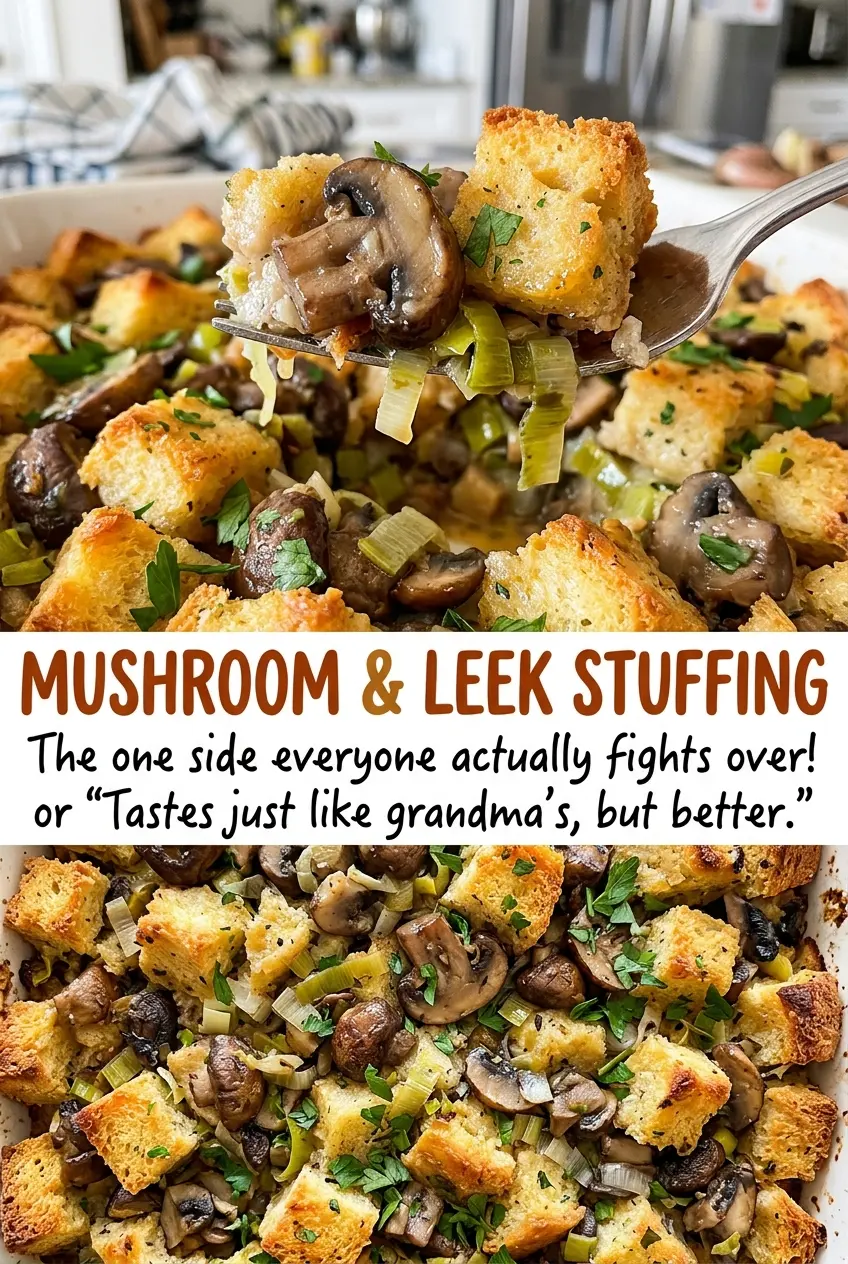
When the foil comes off, the top of this stuffing is golden and crisp while the cubes underneath have softened around the vegetables. That contrast is what I want from Mushroom and Leek Stuffing: enough structure to scoop neatly, with plenty of tender leek and earthy mushroom in each bite.
The leeks bring a mild sweetness, and fresh sage and thyme make the whole dish smell wonderfully savory as it bakes. I use sturdy white bread and dry the cubes in the oven first, so they can take on the broth without collapsing into a dense, wet layer.
This makes a generous side for 10, and it’s satisfying enough to stand on its own as a meatless centerpiece at the table. A little parsley brightens the rich butter and vegetables, while the crisp top gives every serving a bit of texture.
Kitchen Note
Give the baked stuffing the full 10-minute rest before serving. The center settles during that pause, so scoops hold together instead of sliding apart.
Save Mushroom and Leek Stuffing for its crisp golden top, tender vegetables, and fresh sage-and-thyme aroma.
Why the Broth Needs a Dry, Absorbent Bread Base
Stuffing has two jobs to balance: the bread needs enough moisture to become tender, but it also needs to keep its shape. Drying the cubes first gives them room to absorb broth instead of turning limp as soon as the wet ingredients hit. Sturdy bread helps, too; soft, fresh sandwich bread can compress before it has a chance to take up liquid evenly.
The eggs help the mixture set as it bakes, joining the broth and seasonings into a cohesive stuffing rather than leaving loose cubes that tumble off the serving spoon. Tossing the liquid through the bread mixture distributes that binder across the pan. If you pour it all into one spot and leave it there, some pieces get saturated while others stay dry.
There’s also moisture coming from the vegetables. Mushrooms release liquid as they cook, so the skillet mixture needs to be tender and no longer watery before it meets the bread. Keeping those stages in balance gives you a stuffing with a soft center and a browned top, not a soggy middle.
What the Bread, Mushrooms, and Leeks Bring to the Pan
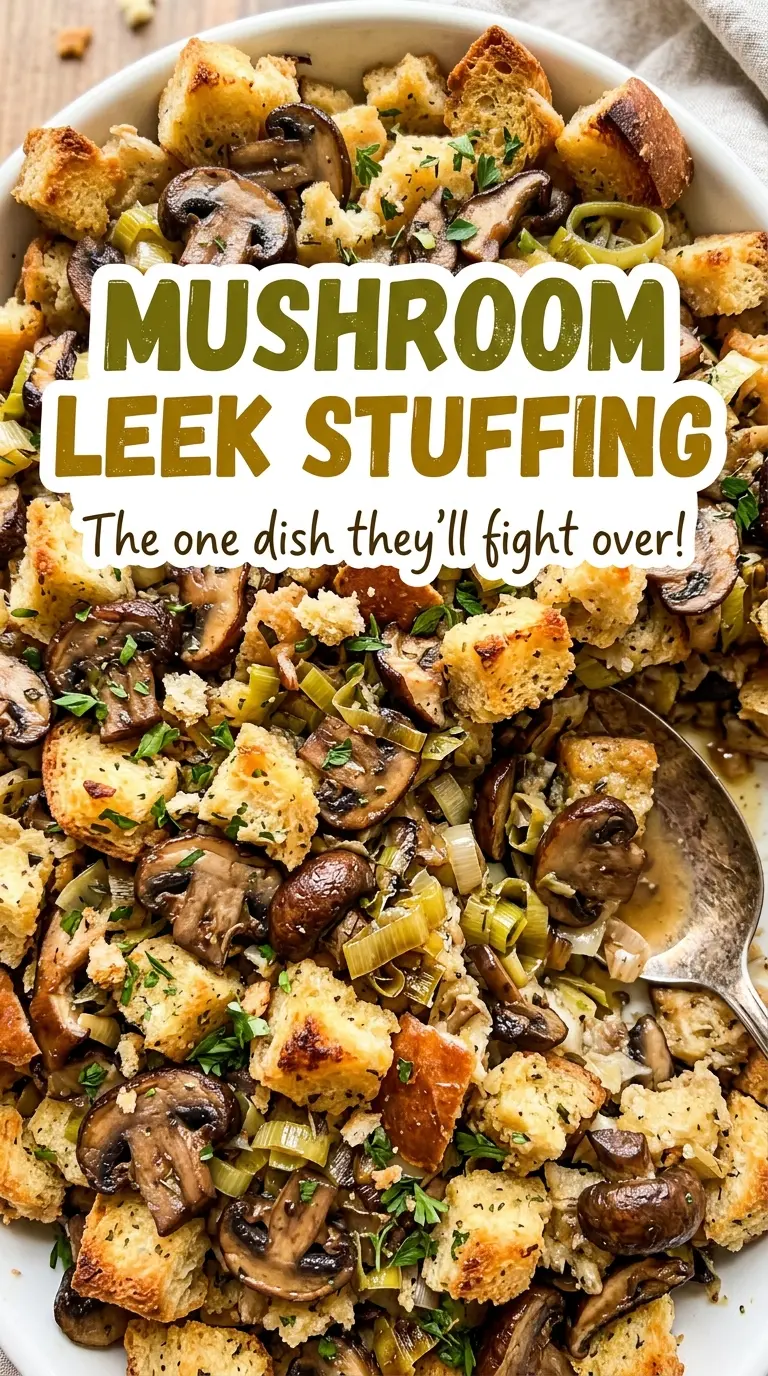
- Sturdy white bread — A basic, firm loaf is a good choice; it doesn’t need to be artisanal, but it should hold a cube shape when tossed. A sturdy country-style white loaf also works, while very soft bread is more likely to turn compact and mushy. Cut the cubes evenly so they dry at a similar rate.
- Leeks — Their gentle onion flavor stays mellow beside the mushrooms. Use only the white and light green parts, slice them thinly, then rinse well; grit hides between the layers, and it’s much less pleasant in a finished bite than a slightly uneven slice.
- Cremini mushrooms — They bring an earthy, savory depth. White button mushrooms are a practical substitute and cook in the same way, though their flavor is milder. Choose mushrooms that feel firm, and trim the ends before slicing.
- Fresh sage and thyme — These herbs give the vegetable mixture its warm, woodsy character. Fresh leaves are worth using here because they’re stirred directly into the skillet and perfume the butter. Strip thyme leaves from their stems and chop the sage before cooking.
- Vegetable broth and eggs — Low-sodium broth lets the herbs and vegetables stay in focus, while eggs help the stuffing hold together once baked. Whisk them with the parsley before adding them to the bread so the liquid is easy to spread evenly.
- Unsalted butter and parsley — Butter carries the flavor of the vegetables and herbs; unsalted butter gives you control over the seasoning. Parsley adds a fresh, green note at the end, so chop it shortly before mixing it into the broth and eggs.
How to Dry the Bread and Build the Stuffing Without Soggy Pockets
Dry the cubes until crisp
Heat the oven to 300°F and spread the bread cubes over two rimmed baking sheets. Bake for 25 to 30 minutes, stirring once, until the cubes feel dry and crisp rather than soft in the middle. If they’re still pliable, give them the full time; the aim is to dry them, not brown them deeply. Raise the oven to 350°F afterward and grease a 9×13-inch baking dish with 1 tablespoon of butter.
Cook the vegetables until the pan is no longer watery
Melt the remaining 5 tablespoons of butter in a large skillet over medium heat, then add the leeks, mushrooms, and celery. Cook for 10 to 12 minutes, stirring as needed, until the vegetables are tender and the liquid released by the mushrooms has evaporated. The mixture should look glossy from the butter, not pooled with water. If liquid remains, keep cooking before moving on.
Season, cool briefly, and coat the bread
Stir in the garlic, sage, thyme, salt, and pepper, and cook for 1 minute so the garlic loses its raw edge. Transfer the vegetables to a large bowl with the bread cubes and let them cool for 5 minutes. Whisk the broth, eggs, and parsley in a separate bowl, then pour it over the bread mixture. Toss until the cubes are evenly moistened, with no puddle of liquid sitting at the bottom.
Bake covered, then uncover for a golden top
Transfer the mixture to the prepared dish and cover it with foil. Bake for 30 minutes, then remove the foil and continue baking for 20 to 25 minutes, until the top is golden and the center reaches 160°F. If the top is browning before the center is ready, keep the foil on a little longer rather than letting the surface get too dark. Let the stuffing rest for 10 minutes before serving.
Two Easy Ways to Adapt Mushroom and Leek Stuffing
Make it gluten-free
Replace the sturdy white bread with a sturdy gluten-free white loaf, then cube and dry it using the same method. Choose bread firm enough to hold its shape; gluten-free loaves vary in texture, and a fragile one may break up more as you toss it with the vegetables and broth.
Make the mushrooms the main event
For a more mushroom-forward pan, replace some of the celery with additional cremini mushrooms. The stuffing will taste earthier and have a softer, more vegetable-rich texture; cook the mushrooms until their released liquid has evaporated before combining them with the bread.
Storage and Reheating
- Refrigerator: Store leftovers in a covered container for 3 to 4 days. The crisp top will soften as it sits.
- Freezer: Freeze cooled portions in an airtight container for up to 2 to 3 months. Thaw in the refrigerator before reheating; the bread may be a little softer after freezing.
- Reheating: Cover a portion with foil and warm it in a 350°F oven until hot throughout, reaching 165°F. Uncover near the end if you want to bring back some crispness; reheating uncovered the whole time can dry out the edges.
Questions That Come Up When Making This Stuffing
Mushroom and Leek Stuffing
Ingredients
Equipment
Method
- Heat the oven to 300°F.
- Spread the bread cubes over 2 rimmed baking sheets and bake for 25 to 30 minutes, stirring once, until dry and crisp.
- Increase the oven temperature to 350°F and grease a 9x13-inch baking dish with 1 tablespoon of the butter.
- Melt the remaining 5 tablespoons butter in a large skillet over medium heat.
- Add the leeks, mushrooms, and celery, and cook for 10 to 12 minutes until tender and the mushroom liquid has evaporated.
- Stir in the garlic, sage, thyme, salt, and pepper and cook for 1 minute.
- Transfer the vegetables to a large bowl with the bread cubes and let cool for 5 minutes.
- Whisk the vegetable broth, eggs, and parsley in a medium bowl.
- Pour the broth mixture over the bread mixture and toss until evenly moistened.
- Transfer the mixture to the prepared baking dish, cover with foil, and bake for 30 minutes.
- Remove the foil and bake for 20 to 25 minutes until the top is golden and the center reaches 160°F.
- Let the stuffing rest for 10 minutes before serving.