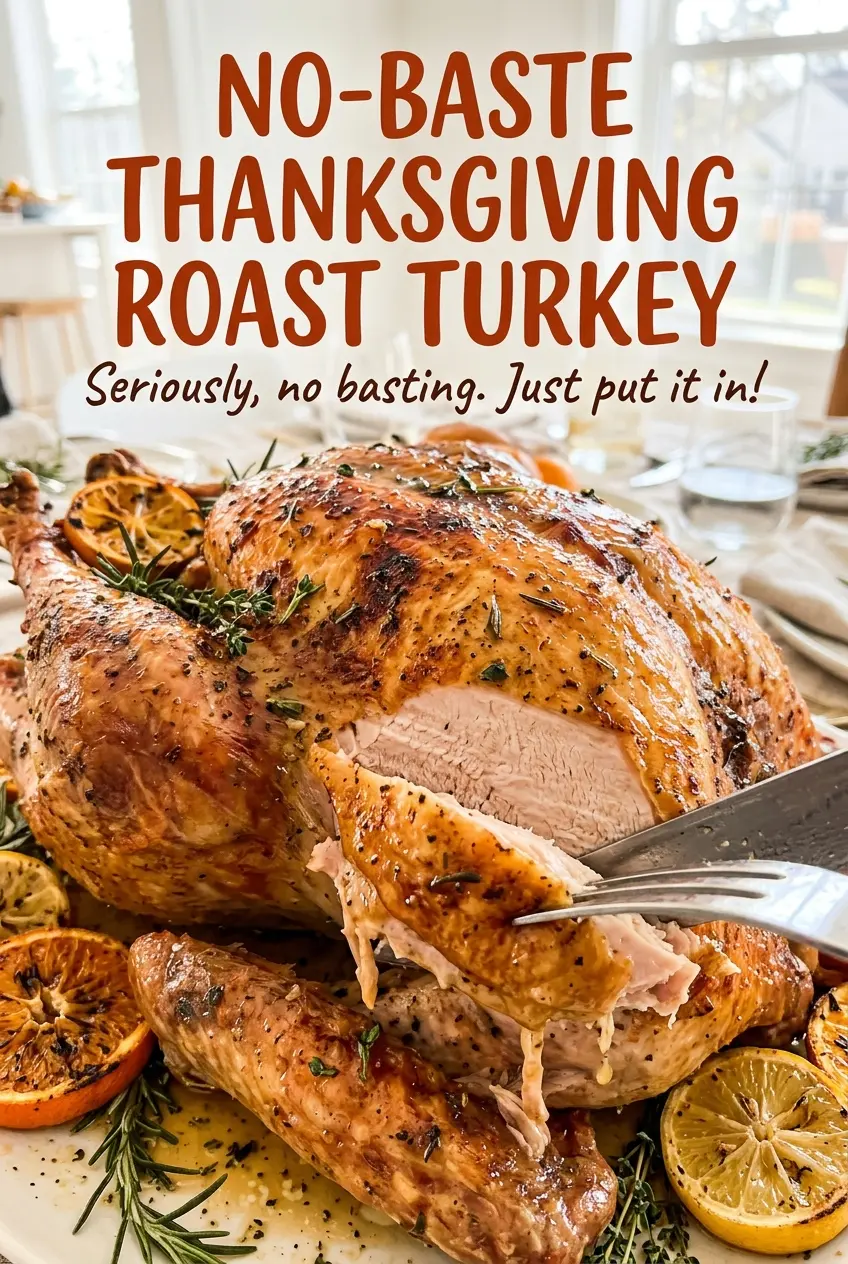
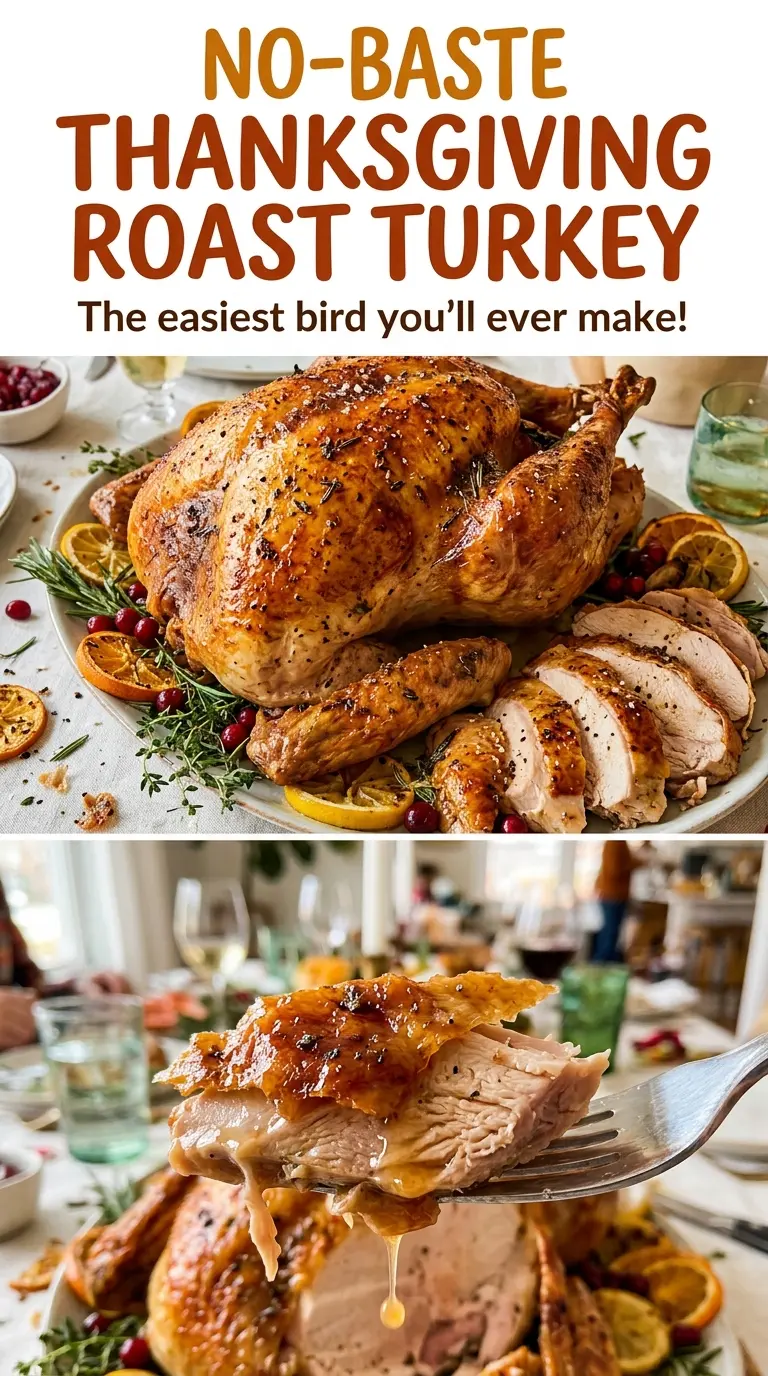
The oven door stays shut, the turkey roasts undisturbed, and the skin has time to brown instead of getting repeatedly wet with pan juices. That’s the practical appeal of this no-baste Thanksgiving roast turkey: it keeps the cooking simple without asking you to give up a golden, herb-scented bird. The thermometer—not a steady round of basting—is what tells you when the meat is ready.
I spread softened butter under the breast skin and over the outside, so the thyme, rosemary, and garlic stay close to the meat as it roasts. Onion and lemon go in the cavity for a gentle aromatic lift. Once the turkey is on the rack, the oven does the rest, and the finished bird comes to the carving board with fragrant skin and tender slices.
Kitchen Note
The butter should be soft enough to smear without sliding off the turkey. If it’s melted and oily, it’s harder to work under the breast skin and won’t stay where you spread it.
Save this No-Baste Thanksgiving Roast Turkey for a holiday centerpiece with golden herb-butter skin and no mid-roast basting.
Why Skipping the Baster Helps the Turkey Skin Brown
Basting sounds like the obvious way to keep a roast turkey moist, but the liquid spooned over the skin doesn’t travel deep into the meat. Each time the oven door opens, heat escapes, and the wet skin has to dry again before it can brown. Leaving the bird alone gives the oven a steadier environment and lets the surface roast rather than cycle between wet and dry.
Moist meat comes down to not cooking the turkey past the point of doneness. That’s why I rely on a thermometer in both the thickest part of the breast and the innermost thigh instead of judging by the skin color or the clock alone. The butter under the breast skin adds flavor right where you want it, while the butter on the outside carries the herbs across the skin. If the skin gets dark before the meat is ready, a loose foil tent slows the browning without changing the no-baste approach.
There’s no need to hover over the roasting pan. Keep the oven closed while the turkey cooks, and use the thermometer readings to decide when it’s ready to come out.
The Butter, Herbs, and Aromatics Each Have a Job
- Whole turkey — Start with a fully thawed bird with the giblets and neck removed. A bird in the stated size range fits the roasting time and method here; check the cavity as well as the outside before seasoning.
- Kosher salt and black pepper — These season both the cavity and skin, so distribute them evenly rather than leaving one area heavily coated. Kosher salt brands vary in crystal size, so use the amount listed instead of swapping in a different salt by volume.
- Unsalted butter — Unsalted butter gives you control over the seasoning while helping the herb mixture spread beneath the skin and over the bird. Use softened butter, not melted butter; a dairy-free variation is included below.
- Fresh thyme, rosemary, and garlic — Fresh herbs give the butter a lively, fragrant flavor, and freshly minced garlic spreads through it more evenly than large pieces would. If you’re choosing between herb bunches, look for leaves that are fresh-looking and aromatic rather than wilted.
- Yellow onion and lemon — Quartering them exposes their cut surfaces inside the cavity, where they lend a mild savory and citrus aroma as the turkey roasts. They complement the herb butter without turning the cavity into a stuffed bird.
How to Roast the Turkey Without Opening the Oven to Baste
Set Up the Pan and Oven
Heat the oven to 325°F and position a rack in the lower third, where the turkey has room to roast evenly. Set a roasting rack inside a large roasting pan before you bring over the bird. The rack lifts the turkey above the bottom of the pan, leaving air space around it as it cooks. Check that the pan is large enough to hold the turkey securely.
Dry and Season the Bird
Pat the turkey dry inside and out so moisture on the surface doesn’t get in the way of browning. Season the cavity and the skin evenly with kosher salt and black pepper. Pay attention to the folds and less-visible areas rather than concentrating the seasoning on the breast alone. A well-dried surface also gives the butter a better base to cling to.
Spread on the Herb Butter
Mix the softened butter with the chopped thyme, chopped rosemary, and minced garlic until the herbs and garlic are distributed throughout. Gently spread some of the mixture under the breast skin, taking care not to tear the skin as you work. Spread the rest over the outside of the turkey so the surface has an even coating. If a thick clump of herbs gathers in one spot, smooth it out with your fingers.
Fill the Cavity and Roast Uncovered
Put the quartered onion and lemon in the cavity, then set the turkey breast-side up on the roasting rack. Roast uncovered for 3 to 3 3/4 hours, without basting. Insert a thermometer into the thickest part of the breast and the innermost thigh; both readings need to reach at least 165°F. If the skin browns too quickly while the turkey is still roasting, loosely tent it with foil.
Rest Before Carving
Transfer the turkey to a carving board when it’s finished roasting, then tent it loosely with foil. Let it rest for 30 minutes before carving so the juices have time to settle back through the meat. Keep the foil loose rather than wrapping the bird tightly. After the rest, carve and serve.
Two Small Changes That Still Suit This Roast
Make It Dairy-Free
Replace the unsalted butter with a firm dairy-free butter alternative in the same volume, then mix it with the thyme, rosemary, and garlic and spread it in the same places. A stick-style alternative is easier to handle under the breast skin than a loose, very soft spread. The herbs still add aroma, though the skin may brown a little differently from a butter-coated bird.
Let Thyme Take the Lead
For a simpler herb butter, leave out the rosemary and keep the listed thyme and garlic. The result has a softer, less piney herbal note while keeping the same roasting method. This is a handy adjustment if rosemary isn’t your favorite or you have thyme on hand but no rosemary.
Storage and Reheating
- Refrigerator: Refrigerate leftover turkey within 2 hours and keep it for 3 to 4 days. The skin will soften once chilled.
- Freezer: Freeze carved portions in airtight packaging for 2 to 6 months for best quality. Thaw frozen portions in the refrigerator before reheating.
- Reheating: Reheat sliced turkey covered in the oven or in the microwave until steaming hot throughout. Warm only what you plan to eat; repeated reheating can dry the meat.
Questions That Come Up Before the Turkey Goes in the Oven
No-Baste Thanksgiving Roast Turkey
Ingredients
Equipment
Method
- Heat the oven to 325°F.
- Set a rack in the lower third and place a roasting rack in a large roasting pan.
- Pat the turkey dry inside and out, then season the cavity and skin evenly with the salt and pepper.
- Mix the softened butter with the thyme, rosemary, and garlic.
- Spread the herb butter under the breast skin and over the outside of the turkey.
- Put the onion and lemon in the cavity.
- Set the turkey breast-side up on the rack.
- Roast uncovered without basting for 3 to 3 3/4 hours, until a thermometer inserted in the thickest part of the breast and the innermost thigh reads at least 165°F.
- Loosely tent the turkey with foil if the skin browns too quickly.
- Transfer the turkey to a carving board and tent loosely with foil.
- Rest for 30 minutes before carving.