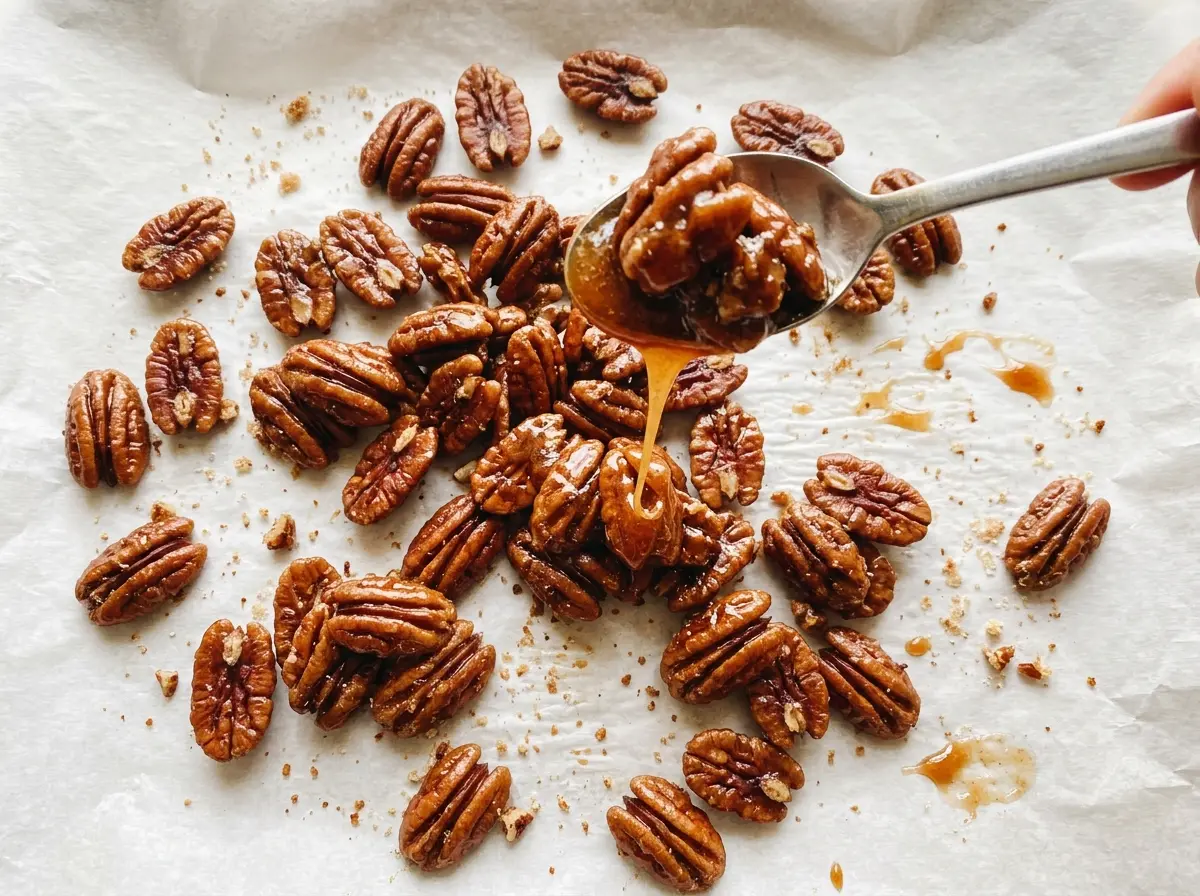
The syrup goes from smooth and glossy to cloudy in just a minute or two, and that change is what turns these praline pecans into tender, crisp-edged clusters instead of a sticky puddle. I keep the lined baking sheet beside the stove before I start; once the pecans are stirred in, there’s not much time to hunt for parchment or clear a counter.
These praline pecans rely on a simple but precise sequence: dissolve the sugars and butter first, let the syrup boil without stirring, then beat it after it comes off the heat. I watch the candy thermometer closely at the boiling stage, and I have a wooden spoon ready for the quick finish. The pecans get coated in a creamy-looking candy shell, with a little chew in the middle and a buttery finish.
Kitchen Note
Set up the parchment and have your spoon ready before the candy comes off the heat. Once the mixture turns cloudy and thickens, scoop the clusters quickly; it firms up as it sits.
Save these praline pecans for a buttery candy treat with tender pecans and crisp, cloudy sugar coating.
Why You Stop Stirring Once the Sugar Syrup Boils
Stirring has two jobs here, and they don’t happen at the same time. Before the syrup boils, stirring helps the granulated sugar and brown sugar dissolve into the evaporated milk and melted butter. Once the mixture reaches a boil, continued stirring can encourage sugar crystals to form along the sides of the pan. Those crystals can make the finished candy grainy instead of smooth.
That pause can feel odd if you’re used to keeping a spoon moving in a saucepan, but it’s the simplest way to let the syrup cook evenly without disturbing it. Use a heavy saucepan so the heat spreads across the bottom, and keep the thermometer where you can read it without leaning over the steam. If sugar crystals cling high on the pan, don’t scrape them back into the syrup. The goal is a clear, bubbling mixture that reaches its candy stage undisturbed, then gets its final stirring only after the pan leaves the heat.
How the Sugars, Milk, and Pecans Shape These Clusters

- Granulated and light brown sugar — Together they give the candy its sweetness and caramel-like depth. Light brown sugar keeps the flavor gentle; dark brown sugar can replace it in the same measure for a deeper molasses note and a darker, more robust candy. Use fresh, soft brown sugar so it blends into the syrup rather than leaving stubborn lumps.
- Evaporated milk — Its concentrated milk solids add body and a creamy quality to the candy. It isn’t the same as sweetened condensed milk, which already contains sugar and would throw off the balance. Choose a plain can; there’s no need for a premium brand.
- Unsalted butter — Butter brings richness and helps round out the cooked sugar. Unsalted butter lets the small amount of kosher salt stay in control. There isn’t a direct dairy-free swap that keeps this exact candy texture and flavor.
- Pecan halves — The halves give each cluster substantial nutty pieces and a pleasing bite. They don’t need to be the most expensive pecans, but avoid nuts that smell stale or bitter. For smaller bites with pecans in every spoonful, use pecan pieces in place of the halves.
- Vanilla extract — Stir it in after the pan comes off the heat so its aroma stays noticeable. A standard pure or imitation vanilla extract works here; the pecans and cooked sugar carry most of the flavor.
From Smooth Syrup to Set Praline Clusters
Get the Pan and Baking Sheet Ready
Line a baking sheet with parchment paper and place it near the stove before you measure out the candy ingredients. Choose a heavy 3-quart saucepan, which gives the bubbling syrup room and helps the heat stay steady. Have a wooden spoon and candy thermometer close at hand, too. Once the pecans go in, stopping to prepare equipment can leave the mixture too thick to portion neatly.
Dissolve the Sugars Before the Boil
Add the granulated sugar, packed light brown sugar, evaporated milk, butter, and kosher salt to the saucepan. Cook over medium heat, stirring, until you can’t see dry sugar and the butter has melted into the mixture. Scrape along the bottom as you stir so no sugar sits in a dry patch. When the syrup reaches a full boil, stop stirring.
Cook the Syrup to Its Candy Stage
Let the mixture boil without stirring until the candy thermometer reads 236°F; this usually takes about 5 to 10 minutes. Watch the thermometer rather than relying on the color, since the sugar mixture can stay fairly pale. Keep the thermometer bulb in the syrup without letting it rest on the bottom of the pan. Pull the saucepan from the heat as soon as it reaches the target.
Beat, Spoon, and Let the Clusters Set
Stir in the pecans and vanilla, then beat the mixture with a wooden spoon for 1 to 2 minutes. It will thicken and turn cloudy, a clear sign that it’s ready to portion. Drop heaping tablespoonfuls onto the prepared parchment, leaving room between each mound. Let the pralines cool until firm, about 20 to 30 minutes; moving them while they’re still soft can distort their shape.
Two Easy Ways to Change the Praline Pecans
Use Dark Brown Sugar for a Deeper Candy Flavor
Swap dark brown sugar for the light brown sugar in the same amount. Its stronger molasses character makes the finished clusters darker and more toffee-like, while the granulated sugar still keeps the candy balanced.
Make Smaller, More Nut-Filled Bites
Use pecan pieces instead of halves, keeping the same amount of pecans. The smaller pieces make the clusters feel more evenly packed with nuts, though you’ll lose the distinct whole-pecan bite of the classic version.
Storage and Reheating
- Room temperature: Keep fully cooled pralines in an airtight container, with parchment between layers, for up to 1 week. Moisture can make the sugar coating tacky.
- Refrigerator: Skip refrigeration; the humidity can soften the candy’s surface.
- Freezer: Freezing isn’t recommended because thawing can leave the coating sticky and change its texture.
- Reheating: These candies are meant to be eaten at room temperature and don’t need reheating.
Questions That Come Up When Making Praline Pecans
Praline Pecans
Ingredients
Equipment
Method
- Line a baking sheet with parchment paper and set it near the stove.
- Combine the granulated sugar, brown sugar, evaporated milk, butter, and salt in a heavy 3-quart saucepan. Cook over medium heat, stirring, until the sugars dissolve and the butter melts.
- Bring the mixture to a boil, stop stirring, and cook until a candy thermometer reads 236°F, about 5 to 10 minutes.
- Remove the pan from the heat, stir in the pecans and vanilla, and beat with a wooden spoon for 1 to 2 minutes until the mixture thickens and turns cloudy.
- Quickly drop heaping tablespoonfuls of the mixture onto the prepared baking sheet, leaving space between each cluster. Let the pralines cool until firm, about 20 to 30 minutes.