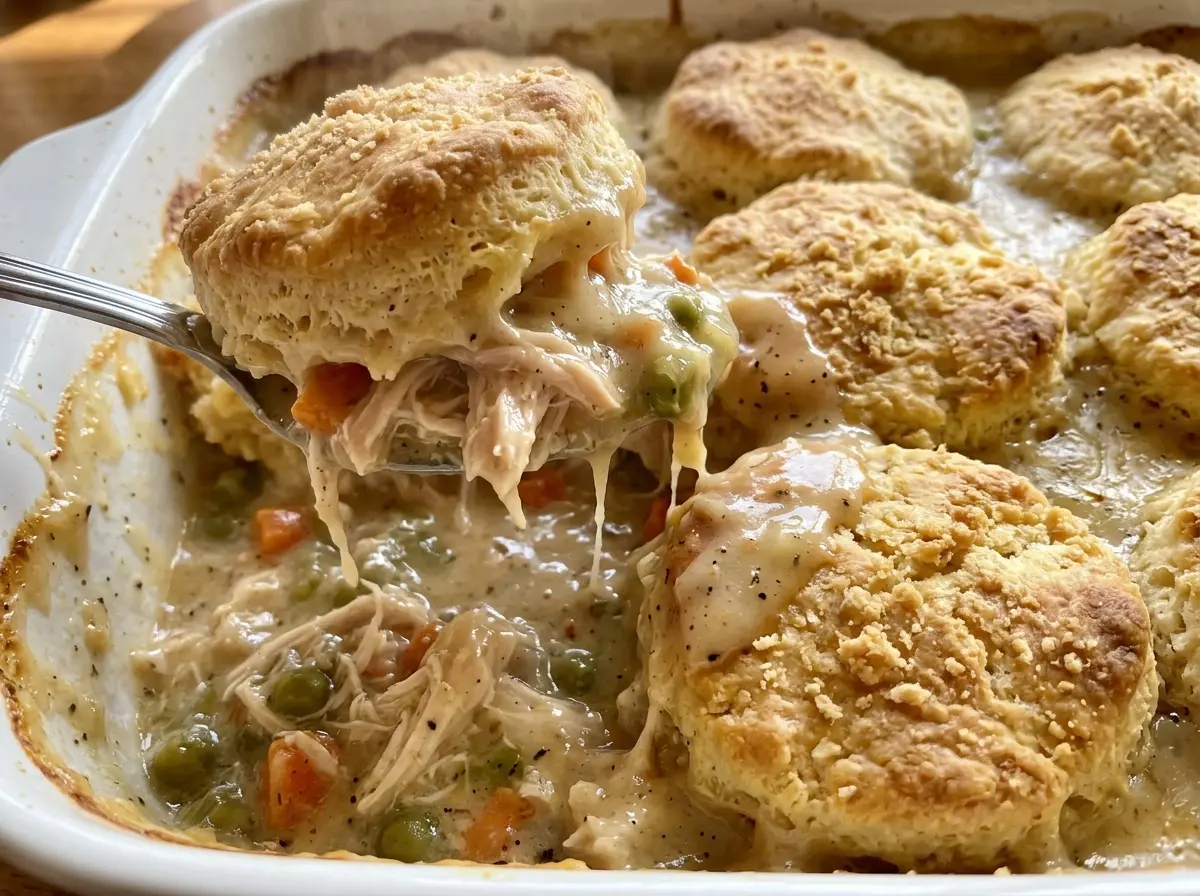
When this casserole comes out of the oven, the biscuit tops are browned and the filling is bubbling around them. It smells like chicken and dumplings, but serves neatly from a baking dish. I like this Southern chicken and dumplings casserole with biscuits because the vegetables, chicken, and creamy gravy all bake under a real biscuit topping, without asking you to shape or roll dumplings.
The filling gets thickened on the stove before it goes into the oven, so the biscuits sit over a substantial gravy instead of a thin broth. I keep the biscuit dough shaggy and spoon it on in separate mounds; those little gaps give the biscuits room to bake while the filling bubbles below. Each serving gets a tender biscuit and a generous scoop of chicken, carrots, celery, and peas.
Kitchen Note
Keep the butter cold while you work it into the flour. If it starts to soften and smear, the biscuits lose the little buttery pieces that help make the crumb tender.
Save this Southern chicken and dumplings casserole for a cozy dinner with creamy chicken filling and golden biscuits baked right on top.
Why This Casserole Thickens on the Stove Before It Hits the Oven
Chicken and dumplings usually brings to mind a pot of broth with dumplings simmering right in it. This casserole takes a different route: the filling is thickened before it goes into the baking dish, and the biscuits bake on top. That order matters because the biscuits need time in the oven to cook through, while the already-thickened filling only needs to heat and bubble. If the sauce starts out watery, the biscuit bottoms absorb more liquid and the finished servings are harder to scoop cleanly.
Let the cornstarch do its work in the saucepan, not just during baking. Once the sauce coats a spoon and the chicken and peas are warmed through, transfer the filling to the dish and top it. The result should be creamy and spoonable, not stiff like a pie filling; the biscuit mounds need the hot filling around them as they bake. That balance gives you a casserole that holds together without losing the soft, gravy-like center that makes chicken and dumplings comforting.
What the Broth, Cornstarch, and Cold Butter Each Bring

- Low-sodium chicken broth — It gives the filling its savory base while leaving room to season with kosher salt. Regular broth can make the finished dish saltier, so taste the filling before adding more seasoning if that’s what you have.
- Whole milk — Milk rounds out the broth and makes the sauce creamy. Two-percent milk works if needed, though the filling won’t taste quite as rich; I wouldn’t replace all the broth with milk, which would make the sauce heavier.
- Cornstarch — This thickens the filling without needing a flour-and-butter roux. Whisk it into cold broth until smooth before it meets the hot liquid; dry cornstarch stirred straight into the saucepan tends to clump.
- Cooked shredded chicken — Leftover roasted chicken or meat pulled from a rotisserie chicken both work well. Shred it into bite-size pieces so it warms evenly and is easy to scoop with the vegetables and gravy.
- Frozen peas — They’re convenient and hold their shape during the short simmer. Add them straight from the freezer rather than thawing them first, so they don’t turn soft while the filling heats.
- All-purpose flour, baking powder, buttermilk, and butter — Standard all-purpose flour is just right here; there’s no need for a specialty brand. Buttermilk gives the biscuits a gentle tang, and cold unsalted butter keeps the topping tender. For a gluten-free version, use a cup-for-cup gluten-free flour blend in the biscuit dough; see the adaptation below.
Build the Filling Thick, Then Bake the Biscuit Topping
Soften the vegetables without browning them
Heat the oven to 425°F and coat a 9×13-inch baking dish with nonstick cooking spray. Warm the vegetable oil in a 4-quart saucepan over medium heat, then add the chopped onion, celery, and carrots. Stir often as they cook for 6–8 minutes, until softened; they should smell sweet and look tender, not dark at the edges. If the pan gets too hot and the onion starts browning, lower the heat so the vegetables soften evenly.
Thicken the broth before adding chicken
Stir 2 3/4 cups of chicken broth and the whole milk into the softened vegetables, then bring the mixture to a gentle simmer. Whisk the cornstarch with the remaining 1/4 cup cold broth until smooth and whisk it into the saucepan. Simmer for 2–3 minutes, stirring, until the sauce thickens rather than staying broth-thin. Stir in 1 teaspoon of the salt and the black pepper, then add the shredded chicken and frozen peas and simmer for about 3 minutes, just until heated through.
Mix the biscuits only until shaggy
Whisk the flour, baking powder, and remaining 1/2 teaspoon salt in a medium bowl. Cut in the cold butter with a pastry cutter or your fingertips until you have coarse crumbs, with small pieces of butter still visible. Stir in the buttermilk just until a shaggy dough forms; stop before it turns smooth or starts to feel elastic. Overworking biscuit dough makes the topping tougher, so don’t knead it to tidy it up.
Top in separate mounds and bake
Transfer the hot filling to the prepared baking dish, then spoon the dough into 8 equal mounds over the top, leaving small gaps between them. The dough doesn’t need to cover every bit of filling; the spaces let the biscuits bake as individual portions. Bake for 25–30 minutes, until the biscuits are golden brown and cooked through and the center of the filling reaches 165°F. Let the casserole rest for 10 minutes before serving so the filling settles enough to scoop.
Easy Changes for a Different Biscuit-Topped Casserole
Make the biscuit topping gluten-free
Replace the all-purpose flour with the same amount of a cup-for-cup gluten-free baking blend that contains xanthan gum. Keep the butter, buttermilk, and method the same; the biscuits may be a little more delicate, so spoon the dough onto the filling rather than trying to shape it by hand. Use gluten-free chicken broth and baking powder as well.
Trade the chicken for cooked turkey
Use the same amount of cooked shredded turkey in place of the chicken. It fits the creamy gravy and biscuit topping just as comfortably, with a slightly deeper roasted flavor. Stir it in with the peas and warm it through as you would the chicken.
Use corn instead of peas
Swap the frozen peas for the same amount of frozen corn and add it with the chicken. Corn makes the filling a little sweeter and keeps the same easy, freezer-to-saucepan prep.
Storage and Reheating
- Refrigerator: Refrigerate leftovers within 2 hours and keep them covered for 3–4 days. The biscuits soften as they sit against the gravy.
- Freezer: Freeze cooled portions in airtight containers for up to 2–3 months. The topping will be softer after thawing, but the filling freezes well.
- Reheating: Thaw frozen portions overnight in the refrigerator. Warm covered in a 350°F oven until hot throughout, then uncover near the end to dry the biscuit tops; microwaving works for a quick portion but leaves the topping softer.
Questions That Come Up With Biscuit-Topped Chicken Casserole
Southern Chicken and Dumplings Casserole with Biscuits
Ingredients
Equipment
Method
- Heat the oven to 425°F.
- Coat a 9x13-inch baking dish with nonstick cooking spray.
- Heat the vegetable oil in a 4-quart saucepan over medium heat; add the onion, celery, and carrots and cook, stirring often, until softened, 6–8 minutes.
- Stir in 2 3/4 cups of the broth and the milk, and bring to a gentle simmer.
- Whisk the cornstarch with the remaining 1/4 cup cold broth in a small bowl until smooth, then whisk it into the saucepan and simmer until the sauce thickens, 2–3 minutes.
- Stir in 1 teaspoon of the salt and the pepper, then add the chicken and peas and simmer until heated through, about 3 minutes.
- Transfer the hot filling to the prepared baking dish.
- Whisk the flour, baking powder, and remaining 1/2 teaspoon salt in a medium bowl.
- Cut in the cold butter with a pastry cutter or your fingertips until the mixture resembles coarse crumbs.
- Stir in the buttermilk just until a shaggy dough forms.
- Spoon the dough into 8 equal mounds over the filling, leaving small gaps between them.
- Bake until the biscuits are golden brown and cooked through and the center of the filling reaches 165°F, 25–30 minutes.
- Let the casserole rest for 10 minutes before serving.