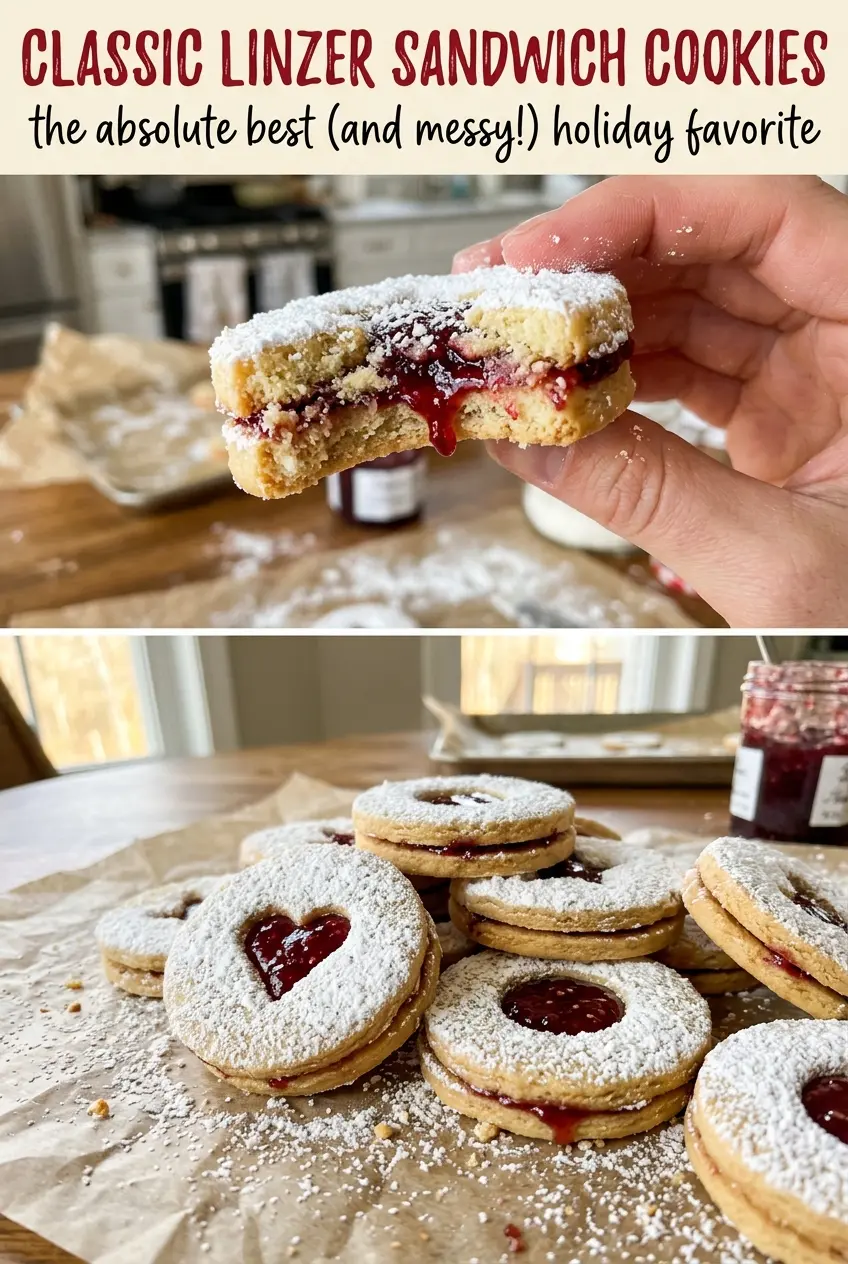
The first thing I watch on a tray of Linzer cookies is the edge of the little window: it should look set, with just the faintest hint of gold. The rounds are delicate, and rushing the chill or baking them until deeply browned can leave you with dry cookies that crumble when you sandwich them. These Classic Linzer Sandwich Cookies stay tender, with a bright raspberry center and a soft dusting of sugar.
The dough gets its texture from a mix of all-purpose flour and almond flour, while lemon zest and cinnamon keep the buttery cookies from tasting flat. I chill the dough before rolling, then give the cut cookies another short rest in the refrigerator. That second chill helps the shapes hold, so the finished tops have neat windows and the cookies look as lovely as they taste.

Kitchen Note
That 10-minute chill after cutting is worth the wait. The openings stay round, and the edges are less likely to soften before baking. Keep the second dough disk in the refrigerator while you work on the first.
Save these Classic Linzer Sandwich Cookies for a bake with buttery almond cookies, bright raspberry filling, and pretty powdered-sugar windows.
Why the Window Stays Small on a 2½-Inch Cookie
The little opening does more than show off the raspberry filling. It leaves enough cookie around the center for the top to stay sturdy when you lift it and set it onto the jam. A 3/4-inch cutout gives you a clear view of the filling without turning the top round into a fragile ring.
That balance matters because these cookies are thin. The dough rolls to 1/8-inch thickness, so a large opening takes away a bigger share of the structure than it would in a thicker cookie. Keep the rounds the same size, too: when each top matches a solid base, the edges line up and the filling stays tucked inside instead of squeezing out unevenly. The sugar-dusted window gives the cookies their familiar look, but it’s the proportion of cookie to filling that makes each sandwich easy to handle.
What the Almond Flour and Raspberry Preserves Each Bring
- Almond flour — It gives the dough a tender, slightly nutty crumb that all-purpose flour alone won’t quite reproduce. A finely ground store-brand almond flour works well; a coarse meal can make the dough feel gritty and the cut edges less neat. Keep it paired with the all-purpose flour rather than swapping one for the other.
- Unsalted butter — Softened butter creams smoothly with the sugar and carries the cookie’s rich flavor. A standard grocery-store butter is fine here; the useful detail is that it should be soft enough to beat but not melted. For a dairy-free version, use firm baking sticks rather than a soft tub spread.
- Egg yolk — The yolk helps bring the dough together without adding the extra moisture of a whole egg. There isn’t a simple egg-white swap that keeps the same tender texture, so use the yolk as listed.
- Lemon zest and cinnamon — Finely grated zest gives the dough a fresh citrus note, and cinnamon adds warmth without making the cookies taste heavily spiced. If you’re out of lemon, finely grated orange zest works in its place and makes the citrus taste sweeter.
- Seedless raspberry preserves — A thick, smooth preserve sits neatly between the cookies and shows clearly through the opening. A budget-friendly jar is perfectly suitable; choose seedless preserves so seeds don’t interrupt the smooth filling. Powdered sugar is best sifted over the tops, which keeps the layer light and even.
The Chilling and Cutting That Keep the Windows Sharp
Creaming the Butter and Sugar
Beat the softened butter and granulated sugar with an electric mixer on medium speed until smooth and creamy, about 2 minutes. Add the egg yolk, vanilla, and finely grated lemon zest, then beat until combined. The mixture should look cohesive rather than streaky. If the butter is still cold and lumpy, give it a little time to soften before you begin.
Mixing and Firming the Dough
Whisk the all-purpose flour, almond flour, cinnamon, and salt in a separate bowl so the spices are distributed. Add that mixture to the butter mixture on low speed, stopping as soon as a soft dough forms. Divide the dough in half, shape each half into a disk, wrap, and refrigerate until firm for at least 1 hour. Don’t keep mixing once the flour disappears; overworking can make the cookies tougher.
Rolling and Cutting the Windows
Heat the oven to 350°F and line two large baking sheets with parchment paper. Roll one disk between sheets of parchment to 1/8-inch thickness, leaving the other disk refrigerated, then cut 24 rounds with a 2 1/2-inch round cutter and reroll scraps as needed. Cut a 3/4-inch opening in the center of half the rounds, arrange the cookies on the prepared sheets, and refrigerate the cutouts for 10 minutes. If the dough gets soft as you work, pause and chill it rather than forcing the cutter through sticky dough.
Baking and Building the Sandwiches
Bake one sheet at a time for 9 to 11 minutes, until the cookies are set and their edges are just beginning to turn golden. Let them cool on the sheet for 5 minutes, then transfer them to a rack to cool completely. Spread 1 teaspoon of raspberry preserves on the flat side of each solid cookie. Sift powdered sugar over the cookies with openings, then place them on the preserves with the powdered-sugar side up.
Swaps That Keep These Linzer Cookies Tender
Use Apricot Preserves for a Milder Center
Replace the raspberry preserves with the same amount of thick, seedless apricot preserves. The filling will taste less tart and more mellow, while keeping the smooth texture that works well in the sandwich.
Make the Dough Dairy-Free
Replace the butter with an equal measure of firm dairy-free baking sticks. Avoid soft tub spread, which can make the dough greasy and difficult to roll. The cookies will have a slightly less buttery taste, but the dough can still be shaped and cut into sandwiches.
Try Orange Instead of Lemon
Use finely grated orange zest in place of the lemon zest. The citrus note becomes rounder and a little sweeter, which pairs especially well with the cinnamon and almond.
Storage and Reheating
- Refrigerator: Store assembled cookies in an airtight container for up to 5 days; the cookies soften gradually around the preserves.
- Freezer: Freeze fully cooled, unfilled cookies in an airtight container with parchment between layers for up to 2 months. Thaw, then add preserves and powdered sugar before serving.
- Reheating: These are best at room temperature, so they don’t need reheating. Don’t microwave assembled cookies; the preserves heat unevenly and the powdered sugar dissolves.
Questions That Come Up With Linzer Sandwich Cookies
Classic Linzer Sandwich Cookies
Ingredients
Equipment
Method
- Beat the butter and granulated sugar in a large bowl with an electric mixer on medium speed until smooth and creamy, about 2 minutes.
- Beat in the egg yolk, vanilla, and lemon zest until combined.
- Whisk the all-purpose flour, almond flour, cinnamon, and salt in a medium bowl.
- Mix the flour mixture into the butter mixture on low speed just until a soft dough forms.
- Divide the dough in half and shape each half into a disk.
- Wrap the disks and refrigerate until firm, at least 1 hour.
- Heat the oven to 350°F.
- Line two large baking sheets with parchment paper.
- Roll one disk between sheets of parchment to 1/8-inch thickness, keeping the other disk refrigerated.
- Cut out 24 rounds with a 2 1/2-inch round cutter, rerolling scraps as needed.
- Cut a 3/4-inch opening in the center of half the rounds.
- Arrange the cookies on the prepared sheets and refrigerate the cutouts for 10 minutes.
- Bake one sheet at a time for 9 to 11 minutes, until the cookies are set and their edges are just beginning to turn golden.
- Cool the cookies on the sheet for 5 minutes.
- Transfer the cookies to a rack to cool completely.
- Spread 1 teaspoon of raspberry preserves on the flat side of each solid cookie.
- Sift the powdered sugar over the cookies with openings.
- Place the cookies with openings on the preserves, powdered-sugar side up.