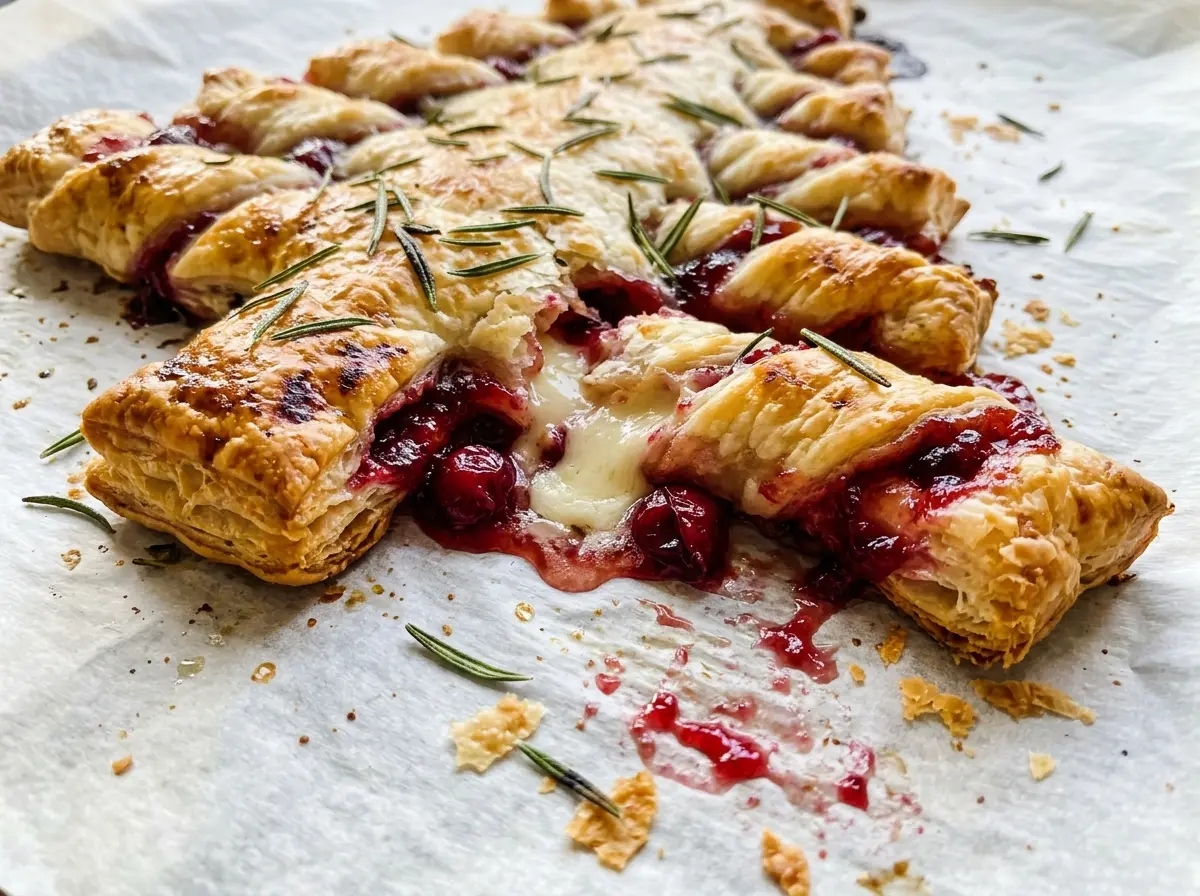
The pastry edges rise first, turning crisp and deeply golden while the Brie softens into the cranberry underneath. That contrast is what makes this tart more than a pretty shape on a platter: every bite has flaky layers, creamy cheese, and a bright pop of whole berries. I cut the tree from one sheet of puff pastry, so it looks festive without needing a special pan or complicated shaping.
Keep the pastry cold as you work with it. Warm puff pastry gets sticky and harder to handle, while a cold sheet rolls and cuts cleanly. I score a border without cutting through, then prick the center so the edges can puff up around the filling. Thin Brie slices melt evenly, and a little fresh rosemary at the end gives the tart a fragrant finish without covering up the cranberry. It’s a simple, shareable centerpiece with crisp edges and a tender, cheesy middle.
Kitchen Note
Thaw the puff pastry until it’s pliable enough to roll, but still cold to the touch. If it starts feeling soft or sticky while you shape the tree, pause and chill it before continuing.
Save this Cranberry Brie Christmas Tree Tart for a holiday spread that looks special but comes together with one sheet of puff pastry.
Why the scored border matters more than the tree shape
The tree shape makes this tart festive, but the border is what gives the pastry a useful job to do. Scoring about half an inch from the edges creates a frame that can puff around the toppings. Pricking the pastry inside that frame gives steam a way to escape, helping the center stay flatter while the outside rises. If you skip the fork pricks, the middle is more likely to balloon unevenly beneath the cranberry and cheese.
Keep the score shallow. Cut all the way through and the border can separate from the center as the pastry bakes; barely mark it and the edge may not puff into a clear rim. You’re looking for a visible line without slicing through the sheet. Spreading the cranberry sauce only inside that line also keeps the edge free to rise and turn crisp. The finished tart should have a defined golden frame around the soft Brie and berry filling, not toppings running onto the bare pan.
Why whole-berry cranberry sauce and Brie work so well together

- Puff pastry — A frozen sheet is convenient and gives you distinct, flaky layers without mixing dough. Look for a sheet that’s intact and thaw it while keeping it cold; once it gets warm, it’s harder to roll and cut neatly. For a gluten-free adaptation, use one sheet of gluten-free puff pastry and roll it to the same rectangle if the dough allows. The layers and browning may differ by brand, but the tart keeps its crisp pastry-and-soft-filling contrast.
- Whole-berry cranberry sauce — The berries bring little pockets of tartness and a more varied texture than a smooth spread. If you only have jellied cranberry sauce, it can stand in; spread it in a thin, even layer so it doesn’t overwhelm the Brie. The finished filling will be smoother and less berry-studded.
- Brie — Thin slices melt across the filling more evenly than thick chunks. Leave the rind on, as it’s part of the cheese and stays in place while you arrange the slices. A regular wedge works well; there’s no need to buy pre-sliced Brie.
- Fresh rosemary — Finely chopped leaves distribute their piney, savory aroma across the finished tart. Fresh rosemary is worth choosing here because it’s sprinkled on after baking, where its fragrance stays distinct. Chop it finely so no one gets a long, woody piece in a bite.
- Egg and water — Whisked together, they make a thin wash that helps the exposed pastry bake to a glossy golden finish. Brush on a light coat rather than letting it pool along the scored line, where excess wash can glue the layers together.
Shape and bake the tart without losing the flaky edges
Roll and cut the Christmas tree
Heat the oven to 400°F and line a 13×18-inch rimmed baking sheet with parchment. Put the cold, thawed pastry on the sheet and roll it into a 10×13-inch rectangle. Cut a Christmas tree shape with a trunk at the bottom, keeping the outline simple so there’s enough pastry to support the toppings. Work with a light touch; pressing hard can flatten the layers you want to puff.
Score the frame and prick the center
With a knife, score a border about 1/2 inch from the edges, stopping before you cut through the pastry. The score should look like a shallow outline around the tree and trunk. Prick the pastry inside the border all over with a fork, keeping the fork marks within the filling area. If a section is missed, that part of the center can rise more than its neighbors.
Brush on the wash and layer the filling
Whisk the egg and water in a small bowl, then brush a thin coat over the pastry. Spread the cranberry sauce inside the scored border, leaving the rim uncovered. Arrange the thin Brie slices evenly over the sauce so the cheese melts across the tree instead of forming a few heavy piles. Keep the pastry border clear as you add the toppings.
Bake until the pastry is deeply golden
Bake at 400°F for 18–23 minutes, until the pastry is puffed and deep golden and the Brie is melted. Go by those visual cues rather than stopping as soon as the cheese softens; the pastry needs time to bake through and turn crisp. If the Brie melts before the pastry is deeply golden, let the tart continue baking and keep an eye on the edges. Rest it for 5 minutes, then sprinkle the finely chopped rosemary over the top before serving.
Easy ways to adapt the tart without losing its character
Use gluten-free puff pastry
Swap in one sheet of gluten-free puff pastry and shape it to the same dimensions, following the dough’s handling needs if it’s more delicate. The layers may not rise quite like traditional puff pastry, but cranberry, Brie, and rosemary still make a balanced filling. Check that the pastry itself suits your dietary needs.
Go smoother with jellied cranberry sauce
Use jellied cranberry sauce in place of whole-berry sauce and spread it thinly inside the border. You’ll still get the sweet-tart cranberry note, but the filling won’t have the little bursts of whole berries. Keep the Brie slices evenly distributed so each portion gets cheese.
Leave off the rosemary for a milder finish
Skip the rosemary if you prefer the cranberry and Brie to be the only strong flavors. The tart will still have its crisp pastry and creamy, tangy filling, with a softer finish and no herbal note.
Storage and Reheating
- Refrigerator: Store leftovers covered for 3–4 days. The pastry will soften as it sits beside the cranberry and Brie.
- Freezer: Freezing the baked tart isn’t my pick; the pastry loses its crisp texture as it thaws.
- Reheating: Warm leftovers in the oven until heated through to bring back some crispness. Skip the microwave if you want to avoid soft, chewy pastry.
Questions that come up when making this Brie tart
Cranberry Brie Christmas Tree Tart
Ingredients
Equipment
Method
- Heat the oven to 400°F and line a 13x18-inch rimmed baking sheet with parchment paper.
- Place the puff pastry on the prepared baking sheet and roll it into a 10x13-inch rectangle.
- Cut the pastry into a Christmas tree shape with a trunk at the bottom.
- Score a border about 1/2 inch from the edges without cutting all the way through.
- Prick the pastry inside the border all over with a fork.
- Whisk the egg and water in a small bowl.
- Brush a thin coat of the egg mixture over the pastry.
- Spread the cranberry sauce inside the border.
- Arrange the Brie slices evenly over the cranberry sauce.
- Bake at 400°F for 18–23 minutes, until the pastry is puffed and deep golden and the Brie is melted.
- Rest the tart for 5 minutes.
- Sprinkle it with the rosemary before serving.