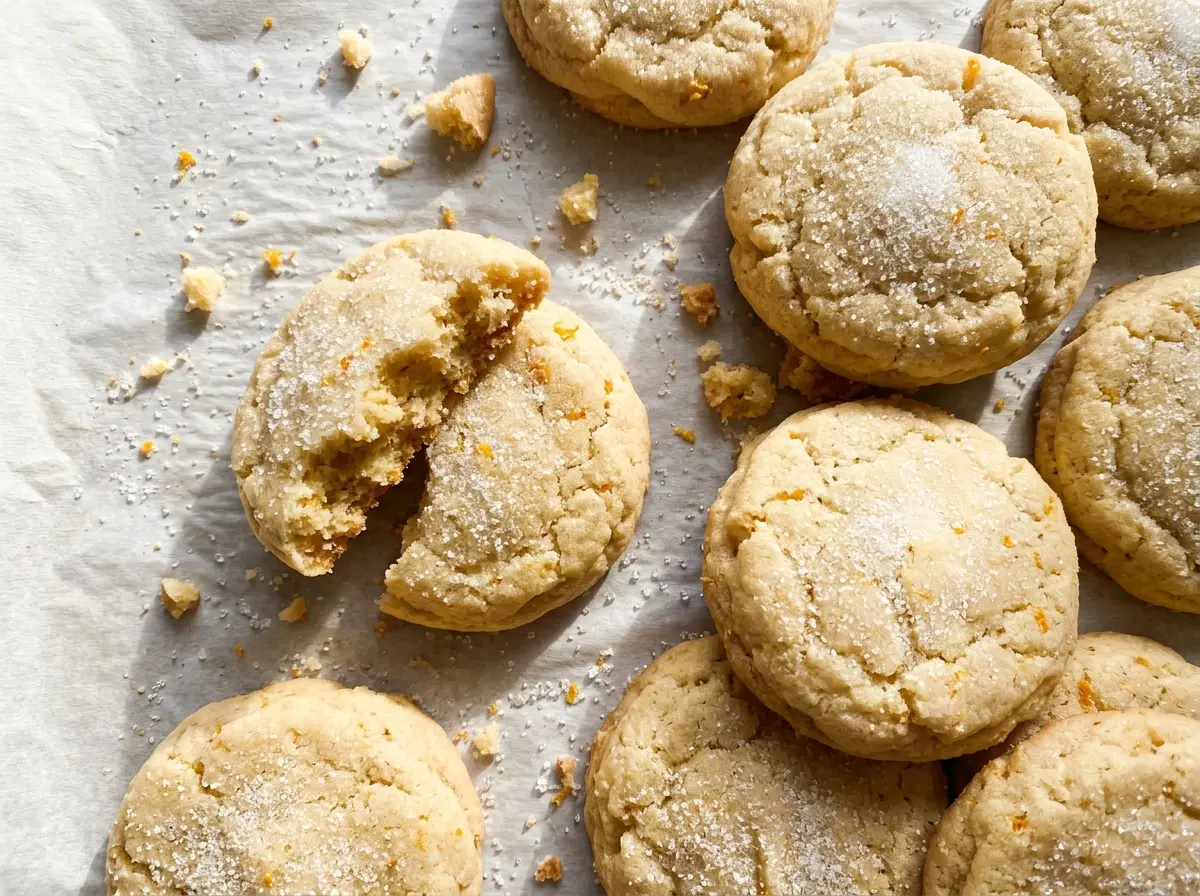
The first tray comes out with lightly golden bottoms and edges that have just set, while the centers still look soft. That small window is what keeps these Winter Orange Sugar Cookies tender instead of dry. A roll in granulated sugar gives each one a delicate, sparkly coating, and finely grated orange zest brings a bright citrus scent to the dough.
I chill the dough until it’s firm enough to roll, then bake one sheet at a time so the cookies have room to spread evenly. Cardamom adds a gentle warm note without drowning out the orange. The dough is straightforward to mix, but the short rest makes it much easier to portion into neat balls and coat in sugar. Each cookie has a soft center, a lightly crisp edge, and a clean orange finish.
Kitchen Note
Once the dry flour disappears, stop mixing. A few streaks are easy to work in with a final scrape, but extra mixing can make the cookies tougher.
Save these Winter Orange Sugar Cookies for a citrusy bake with soft centers, sugared edges, and a gentle cardamom finish.
Why the Dough Needs a Chill Before It Gets Rolled in Sugar
Butter that’s soft enough to cream is also soft enough to make cookie dough sticky. Give the dough 30 to 45 minutes in the refrigerator, until it feels firm enough to scoop and roll. That pause firms the butter back up, so the portions hold their shape while you coat them in sugar and arrange them on the baking sheet.
Use the texture cue as well as the clock. If the dough still clings heavily to your hands or slumps as you roll it, it needs more time to firm; if it’s easy to handle, you’re ready to portion. Chilling also gives you a more manageable dough without adding flour, which could make the baked cookies dry. Cover the bowl while it rests so the surface doesn’t dry out or pick up refrigerator odors.
There’s a practical payoff, too: you can roll and coat the portions without fighting a greasy, sticky dough. Work with one sheet’s worth at a time, and keep the rest covered while the first batch bakes. The dough should feel cool and pliable, not hard.
Why Orange Zest and Cardamom Need Different Jobs in These Cookies

- Orange zest — Finely grated zest supplies the concentrated citrus aroma without adding juice or extra liquid to the dough. A fresh, firm orange is easiest to zest; stop before you reach the bitter white pith. Lemon zest works as a direct swap if you want a sharper citrus note.
- Ground cardamom — Cardamom gives the orange a softly warm, aromatic partner. Freshly opened spice tends to smell more vivid, but a regular grocery-store jar is fine if it still smells fragrant. Ground cinnamon can replace it for a rounder, more familiar spice note.
- Butter and granulated sugar — Unsalted butter keeps the salt level in your hands, while granulated sugar helps create the light, crisp coating on the outside. The butter should be softened enough to beat smoothly, not melted; melted butter won’t cream into the same light mixture.
- Flour and leaveners — All-purpose flour gives the cookies their structure, and the baking soda and baking powder work together to give the dough lift. A cup-for-cup gluten-free baking blend that includes xanthan gum is the most practical flour swap, though the finished texture may be a little more delicate.
- Egg and vanilla — The egg helps bind the dough and contributes to its tender texture. Vanilla rounds out the orange and spice, so use an extract you like; there’s no need to reach for an expensive specialty bottle.
From Fluffy Butter to Soft Centers and Golden Edges
Whisk the dry ingredients evenly
Heat the oven to 350°F and line an 18×13-inch rimmed baking sheet with parchment paper. Whisk the flour, baking soda, baking powder, kosher salt, and cardamom together in a medium bowl. Break up any little clumps of spice or leavener as you whisk. An even mixture helps keep the cardamom from gathering in one bite.
Cream the butter with the orange zest
Beat the softened butter with 1 1/2 cups of the sugar and the finely grated orange zest in a large bowl. Give it about 2 minutes, until the mixture looks light and fluffy rather than dense and greasy. Scrape the bowl so the zest and butter at the bottom get incorporated. If the butter is too firm, it won’t blend smoothly; if it’s melted, it won’t aerate properly.
Add the egg, vanilla, and flour mixture
Beat in the egg and vanilla until combined, scraping down the bowl as needed. Add the flour mixture and mix on low just until no dry flour remains. The dough will be soft, but it shouldn’t have loose pockets of flour around the bowl. Stop as soon as it comes together so the cookies stay tender.
Chill, scoop, and coat
Cover the dough and refrigerate it for 30 to 45 minutes, until firm enough to roll. Put the remaining 1/4 cup sugar in a shallow bowl, then scoop the dough into 1 1/2-tablespoon portions and roll each one into a ball. Coat each ball in sugar and arrange 12 on the prepared sheet, spacing them about 2 inches apart. A shallow bowl makes it easier to turn each ball through the sugar without crushing it.
Bake until the edges are set
Bake one sheet at a time for 10 to 12 minutes, until the edges are set and the bottoms are lightly golden. The centers can still look soft when the cookies come out; don’t wait for them to turn deeply golden. Let the cookies cool on the baking sheet for 5 minutes, then transfer them to a wire rack to cool completely. Repeat with the remaining dough.
Three Flavor and Flour Swaps That Still Suit These Cookies
Trade the orange for lemon
Replace the orange zest with the same amount of finely grated lemon zest. The cookies will taste brighter and more tart, while the cardamom still gives them a warm finish.
Use cinnamon instead of cardamom
Swap the ground cardamom for the same amount of ground cinnamon. The spice tastes warmer and more familiar, and the orange still comes through clearly.
Make them gluten-free
Replace the all-purpose flour with the same amount of a cup-for-cup gluten-free baking blend that contains xanthan gum. The cookies keep their orange-cardamom flavor, though their texture may be a little more delicate than the original.
Storage and Reheating
- Refrigerator: These cookies don’t need refrigeration. Keep them in an airtight container at room temperature for up to 5 days; the refrigerator can make them firmer.
- Freezer: Freeze fully cooled cookies in an airtight container, with parchment between layers, for up to 2 months. Thaw them at room temperature.
- Reheating: They’re good at room temperature, but a 5-second microwave warm-up softens one cookie. Longer heating can make it too soft and then tough as it cools.
Questions That Come Up While Baking Orange Sugar Cookies
Winter Orange Sugar Cookies
Ingredients
Equipment
Method
- Heat the oven to 350°F.
- Line an 18x13-inch rimmed baking sheet with parchment paper.
- In a medium bowl, whisk together the flour, baking soda, baking powder, salt, and cardamom.
- In a large bowl, beat the butter, 1 1/2 cups of the sugar, and orange zest until light and fluffy, about 2 minutes.
- Beat in the egg and vanilla until combined, scraping down the bowl as needed.
- Add the flour mixture and mix on low just until no dry flour remains.
- Cover the dough and refrigerate for 30 to 45 minutes, until firm enough to roll.
- Put the remaining 1/4 cup sugar in a shallow bowl.
- Scoop the dough into 1 1/2-tablespoon portions and roll each portion into a ball.
- Coat each dough ball in sugar.
- Arrange 12 balls on the prepared baking sheet, spacing them about 2 inches apart.
- Bake one sheet at a time for 10 to 12 minutes, until the edges are set and the bottoms are lightly golden; repeat with the remaining dough.
- Let the cookies cool on the sheet for 5 minutes.
- Transfer the cookies to a wire rack to cool completely.