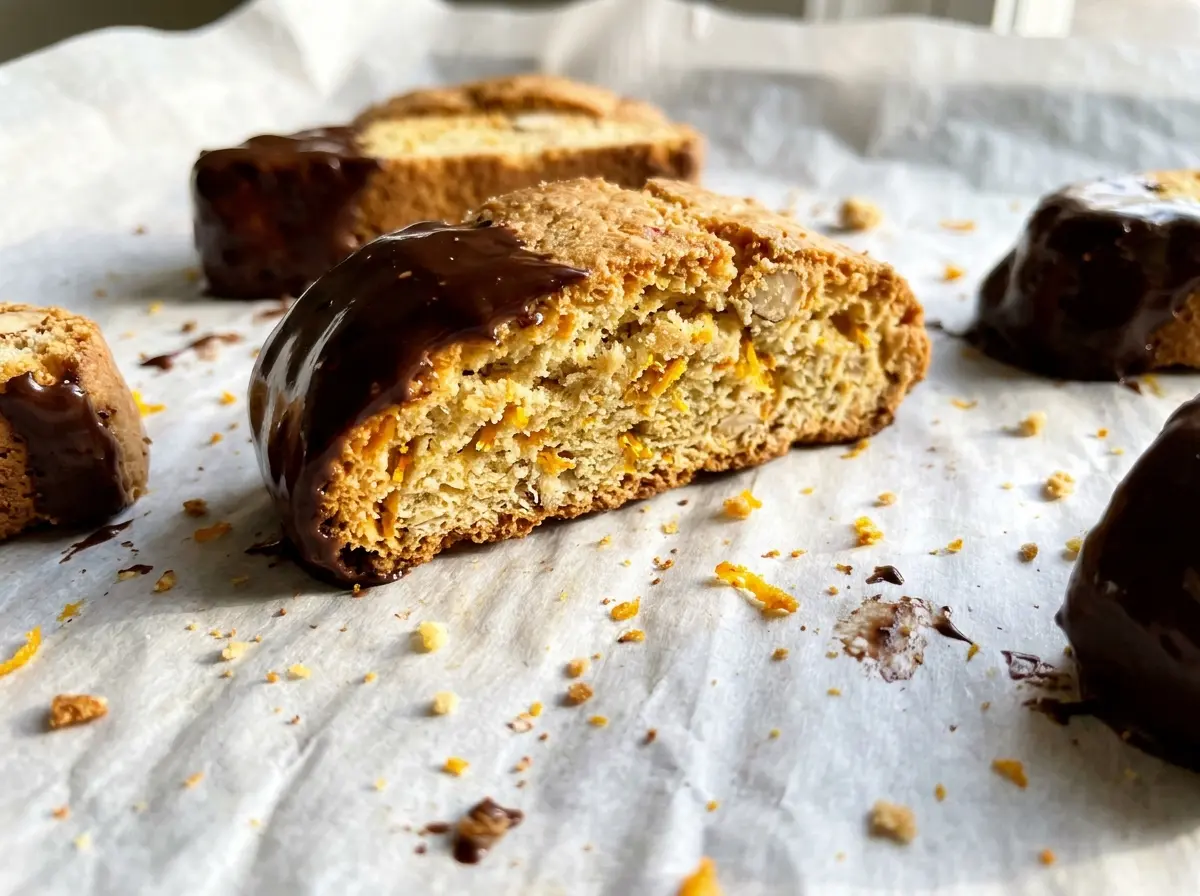
When the biscotti logs come out of the oven, they look more like soft-edged loaves than the crisp cookies you expect. That first bake sets the dough; the slices get their dry, dunkable crunch later. With Chocolate Dipped Orange Biscotti, the orange zest perfumes the dough while it bakes, and a dip in semisweet chocolate gives each piece a little bittersweet finish.
I shape the dough into two narrow logs so they bake evenly and leave enough room between them to spread. After a short rest, a serrated knife cuts through the logs without pressing them flat. The second bake is gentler, and turning the slices helps dry both sides instead of leaving a soft center.
Let the biscotti cool completely before dipping, then give the chocolate time to set on parchment. You’ll end up with crisp orange-scented slices and a neat chocolate edge.
Kitchen Note
Give the logs the full 10 minutes on the baking sheet before slicing. They’re still warm, but that brief rest helps them hold their shape under the knife instead of crumbling at the edges.
Save these Chocolate Dipped Orange Biscotti for a crisp, citrus-scented cookie with a semisweet chocolate finish.
Why the Second Bake, Not the First, Makes Biscotti Crisp
Biscotti get their signature texture from two different jobs in the oven. The first bake cooks the dough in log form, setting the outside while the middle stays tender enough to slice cleanly. Trying to get a crisp cookie at this stage would mean baking the logs too long before you cut them, which makes slicing harder and the pieces more likely to break.
Once the logs are sliced, the second bake exposes the cut surfaces to the heat. That’s when moisture escapes and the crumb dries into a firm, crisp bite. Turning the slices midway through helps each face dry evenly; otherwise, the underside can stay a little soft while the top feels done.
Look for dry, crisp slices before they leave the oven, not a deep brown color. These biscotti are meant to be lightly golden from the first bake and crisp from the second. Their firm texture also makes them easy to handle once the chocolate goes on.
The Ingredients That Shape Biscotti’s Crumb and Orange-Chocolate Finish

- All-purpose flour — It gives the dough enough structure to hold its log shape and makes a sturdy slice after baking. Spoon it into the measuring cup and level it rather than packing it down; too much flour can make the dough stiff and the biscotti dense.
- Eggs — Room-temperature eggs blend more easily with the melted butter and help the dough come together without cold, firm bits of butter. They’re part of the structure here, so I wouldn’t replace them with a liquid egg substitute.
- Unsalted butter — Melted butter adds richness without making the dough as soft as creamed butter would. Let it cool before whisking it with the eggs; hot butter can make the mixture less cohesive.
- Orange zest and vanilla — Finely grated zest carries the orange aroma through the dough without adding juice, which would change its moisture. Use fresh zest and avoid grating the bitter white pith. Vanilla rounds out the citrus, so measure it carefully rather than pouring by eye.
- Semisweet chocolate — Finely chopped pieces melt more evenly than large chunks, especially in short microwave bursts. A good-quality bar gives you a smooth dip, but there’s no need to choose an expensive one when the chocolate is just a thin finish.
Build the Logs First, Then Dry the Slices
Bring the dry and wet mixtures together
Heat the oven to 350°F and line a large rimmed baking sheet with parchment paper. Whisk the flour, sugar, baking powder, and salt in a large bowl; in a medium bowl, whisk the eggs, melted and cooled butter, orange zest, and vanilla. Stir the wet mixture into the dry ingredients until a soft dough forms. Stop once there are no dry pockets, since working the dough more than needed can make the biscotti tough.
Shape two narrow logs
Divide the dough in half and shape each portion into a 12-by-2-inch log on the prepared baking sheet. Keep at least 3 inches between the logs so they have room to spread as they bake. Aim for even thickness from end to end; a narrow spot will bake faster than the rest. Smooth the edges with your hands so the logs hold together for slicing.
Set the logs in the first bake
Bake at 350°F for 25 to 30 minutes, until the logs are set and lightly golden. The centers should no longer look like raw dough, but the logs don’t need to be deeply browned. Let them cool on the baking sheet for 10 minutes before moving them to a cutting board. That short pause firms them up without making them brittle.
Slice and bake until crisp
Reduce the oven to 325°F, then slice each log diagonally into 1/2-inch-thick pieces with a serrated knife. Arrange the slices cut-side down on the baking sheet and bake for 10 to 12 minutes. Turn each piece over and bake for another 10 to 12 minutes, until the slices feel dry and crisp. If the slices are crowded, give them room so hot air can reach their cut faces.
Cool completely before dipping
Transfer the biscotti to a wire rack and let them cool completely before preparing the chocolate. Put the finely chopped chocolate in a microwave-safe bowl and heat it at 50% power in 30-second intervals, stirring after each interval until smooth. Dip one end of each biscotti in the melted chocolate, then set it on parchment until the chocolate is set. If the chocolate still has small unmelted pieces, stir before deciding whether it needs another interval.
Three Useful Ways to Adapt These Orange Biscotti
Bake them without the chocolate
Leave off the chocolate dip and enjoy the orange biscotti plain. The citrus comes through more clearly, and the cookies are less sweet; keep the dough and both bakes the same.
Try a gluten-free baking blend
For a gluten-free version, replace the all-purpose flour with an equal volume of a cup-for-cup gluten-free baking blend made for baking. A blend with a binder such as xanthan gum is a better fit for a sliceable log; expect a slightly different crumb, and handle the baked logs gently.
Cut straight across for shorter pieces
Slice crosswise instead of diagonally, keeping the slices 1/2 inch thick. You’ll get shorter pieces that are easy to fit in a small mug, with the same orange flavor and crisp texture.
Storage and Reheating
- Refrigerator: Store the biscotti in an airtight container at room temperature for up to 2 weeks; refrigeration isn’t needed and can soften the crisp texture.
- Freezer: Freeze the cooled, undipped biscotti in an airtight container, separating layers with parchment, for up to 2 months. Thaw at room temperature before dipping or serving.
- Reheating: They’re best at room temperature. Avoid warming chocolate-dipped biscotti, since heat softens the chocolate and can take the crunch out of the cookie.
Questions That Come Up While Baking Biscotti
Chocolate Dipped Orange Biscotti
Ingredients
Equipment
Method
- Heat the oven to 350°F.
- Line a large rimmed baking sheet with parchment paper.
- Whisk the flour, sugar, baking powder, and salt in a large bowl.
- Whisk the eggs, melted butter, orange zest, and vanilla in a medium bowl.
- Stir the egg mixture into the flour mixture until a soft dough forms.
- Divide the dough in half.
- Shape each half into a 12-by-2-inch log on the prepared baking sheet, spacing the logs at least 3 inches apart.
- Bake for 25 to 30 minutes, until the logs are set and lightly golden.
- Cool the logs on the baking sheet for 10 minutes.
- Reduce the oven to 325°F.
- Transfer the logs to a cutting board.
- Slice each log diagonally into 1/2-inch-thick pieces with a serrated knife.
- Arrange the slices cut-side down on the baking sheet.
- Bake for 10 to 12 minutes, turn them over, then bake for another 10 to 12 minutes, until dry and crisp.
- Transfer the biscotti to a wire rack and cool completely.
- Melt the chopped chocolate in a microwave-safe bowl at 50% power in 30-second intervals, stirring after each interval, until smooth.
- Dip one end of each cooled biscotti in the chocolate.
- Place the biscotti on parchment until the chocolate is set.