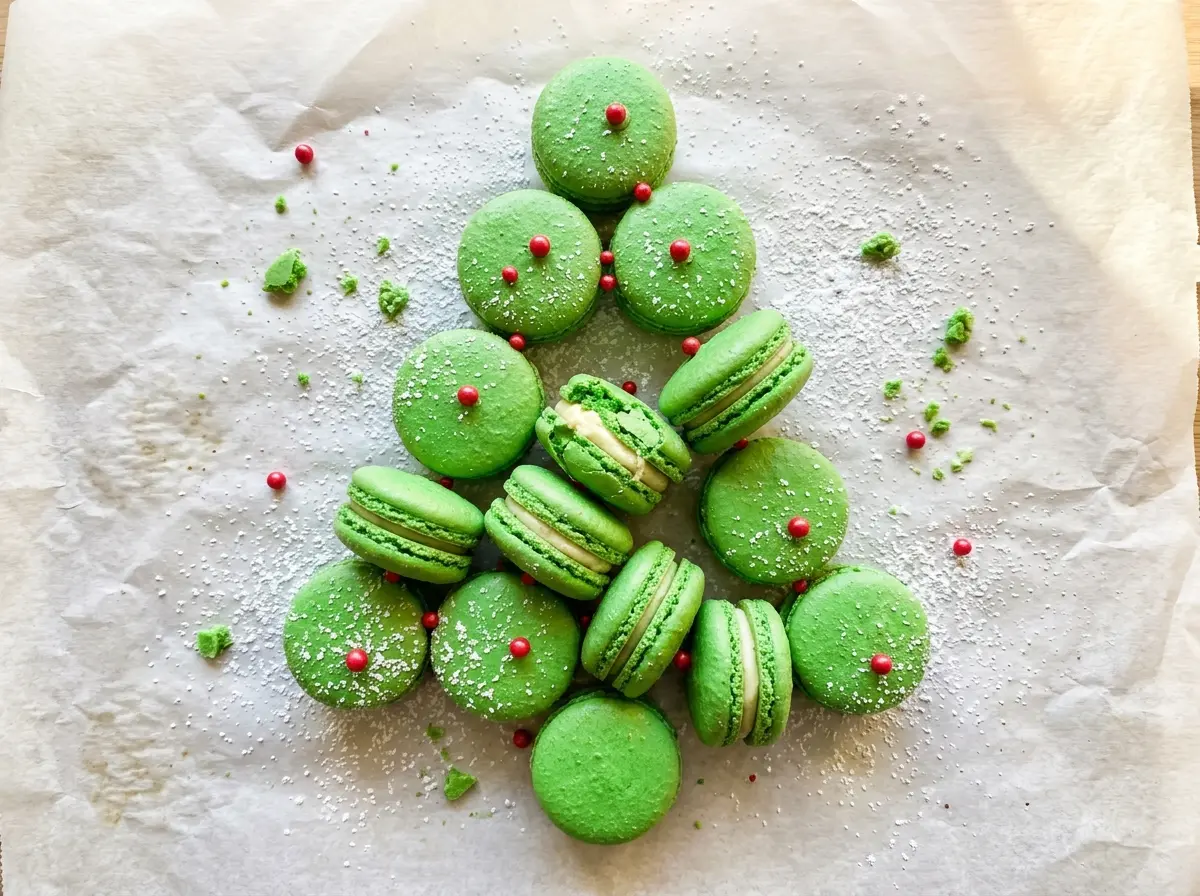
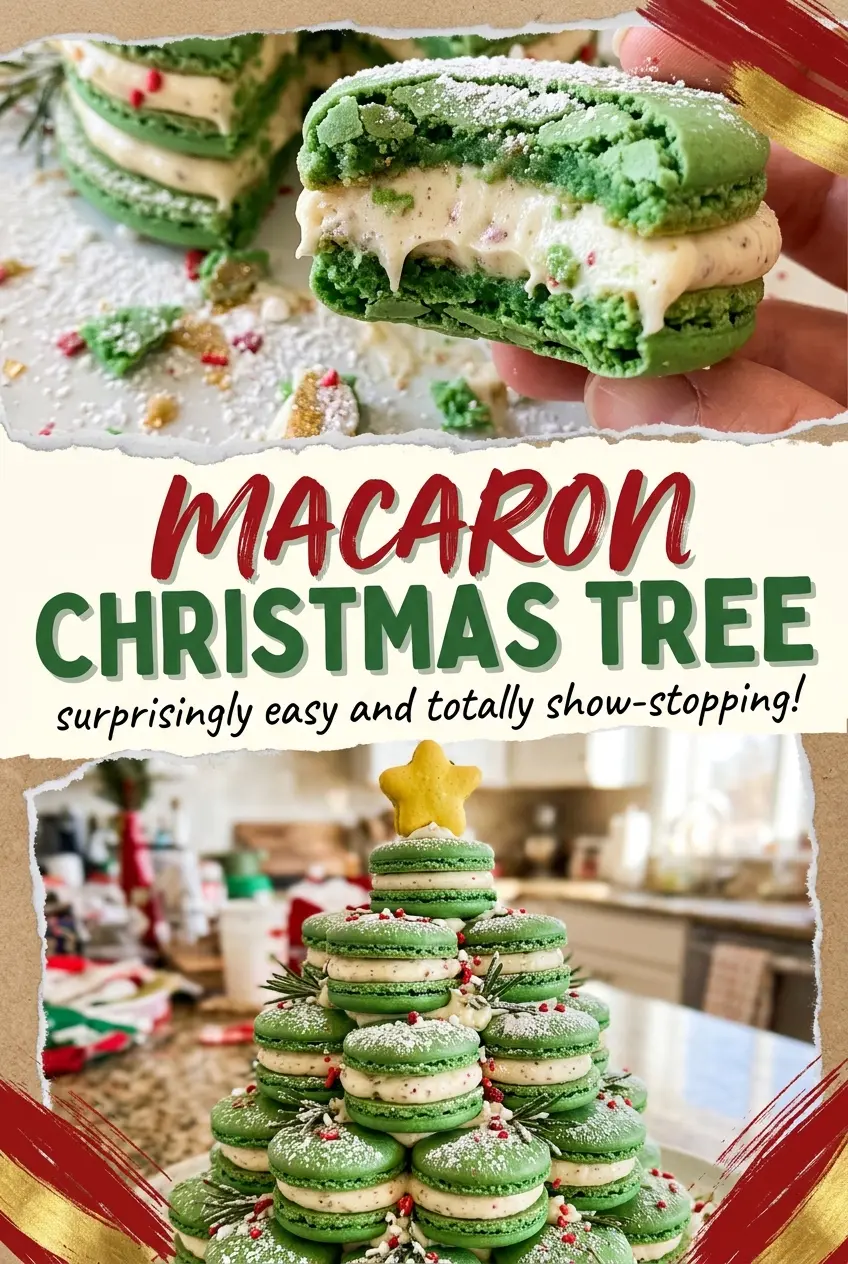
A macaron shell should lift cleanly from the parchment, not leave its bottom behind. That little test matters even more when you’re making enough shells to build a centerpiece. For this Macaron Christmas Tree, the green shells are filled, chilled to mature, then arranged in tidy rows on a platter with a gold star at the top.
I pay close attention to the batter before it ever reaches the piping bag. Fold the almond mixture in gradually, and stop when the batter falls from the spatula in a thick ribbon that blends back in within about 10–15 seconds. That gives the shells enough body to hold their round shape without piping peaks. Once they’re baked and paired, the buttercream holds each macaron in place as the tree comes together, with white nonpareils for a simple finishing touch.
Kitchen Note
I stop folding when the batter moves as one thick ribbon, not when it looks glossy in the bowl. If it runs off the spatula like a stream, it’s gone too far to hold neat circles.
Save this Macaron Christmas Tree for a centerpiece with crisp green shells, soft vanilla buttercream, and a gold star on top.
Why a Dry Shell Top Matters More Than a Longer Bake
Macarons need a short rest after piping so a dry skin can form on the surface. That skin gives the top a chance to set as the shells rise in the oven, while the characteristic feet form around the bottom edge. Put tacky shells straight into the oven and the tops are more likely to crack or spread unevenly. Turning up the heat to compensate isn’t the fix; these shells bake at a moderate 300°F and should finish without browning.
The wait isn’t identical in every kitchen. Give the shells 30–60 minutes and use the surface, not the clock alone, as your cue: a light touch should feel dry rather than sticky. A humid room may push the rest toward the longer end. This pause is easy to overlook when you’re eager to get the tree assembled, but it’s what gives the shells a better chance of baking into neat, smooth rounds that are easy to pair and stack.
What Gives These Green Shells Their Structure and Finish
- Super-fine almond flour — It gives the shells their structure and delicate chew. A finely ground flour is worth choosing; sift it and press larger pieces through so coarse bits don’t interrupt the smooth tops. Wheat flour isn’t a one-for-one substitute here.
- Powdered and granulated sugar — The powdered sugar blends into the almond flour for the shells and makes the buttercream smooth, while granulated sugar dissolves into the egg whites as they whip. Keep the two portions separate. Swapping one type of sugar for the other changes how the shell batter or buttercream behaves.
- Room-temperature egg whites — These whip into the meringue that holds the shells up. Bring them to room temperature before beating; fresh whites separated from eggs give predictable volume. Carton whites can vary in how well they whip.
- Green gel food coloring — Gel gives the batter color without adding much liquid. Use gel rather than liquid coloring, which can loosen a carefully balanced macaron batter.
- Unsalted butter, heavy cream, and vanilla — Softened butter is the base of the filling, cream helps it turn fluffy, and vanilla gives it a familiar sweet aroma. The butter should be soft enough to beat smoothly, not melted. The separate salt keeps the sweetness in check.
- White nonpareils and the gold star — The small white sprinkles read like ornaments against the green shells, while the single star gives the tree a clear top. Both are decorations rather than structural ingredients, so the macarons still sandwich and stack if you leave either off.
From Smooth Meringue to a Tree That Holds Together
Build a glossy, stable meringue
Heat the oven to 300°F with a rack in the center, then line two 13×18-inch half-sheet pans with parchment and draw 28 circles, 1½ inches wide, on the underside of each sheet. Sift the almond flour and the shell portion of the powdered sugar together, pressing larger bits through the sieve. Beat the room-temperature egg whites on medium until foamy, then add the granulated sugar gradually. Increase to medium-high and beat for 5–7 minutes, adding the green gel coloring during the last minute, until the peaks are stiff and glossy.
Fold and pipe circles of even size
Fold the sifted dry mixture into the meringue in three additions, scraping and pressing the batter against the side of the bowl as you go. Stop when it falls from the spatula in a thick ribbon and blends back into itself within about 10–15 seconds. Transfer it to a piping bag fitted with a ½-inch round tip and pipe into the drawn circles. Tap each pan firmly on the counter a few times, then pop visible air bubbles with a toothpick.
Rest the shells, then bake one pan at a time
Leave the piped shells at room temperature for 30–60 minutes, until their tops feel dry and are no longer tacky. Bake one pan at a time for 15–18 minutes. Look for formed feet and tops that feel set; the shells shouldn’t brown. Let them cool completely on the pans, at least 20 minutes, before peeling them from the parchment, since warm shells are more likely to break.
Fill, mature, and arrange the tree
Beat the softened butter on medium for 1–2 minutes until creamy. Add the remaining powdered sugar, vanilla, heavy cream, and salt; beat on low until combined, then on medium-high for 2 minutes until fluffy. Match the cooled shells in pairs by size and pipe about 1 teaspoon of buttercream onto the flat side of one shell in each pair, then sandwich gently. Set the filled macarons in a single layer in an airtight container and refrigerate for 12–24 hours to mature. Let them stand at room temperature for 30 minutes, then pipe a small dab of buttercream beneath each one to anchor it to a 12-inch platter; arrange centered rows of 7, 6, 5, 4, 3, 2, and 1, nesting each upper row into the gaps below. Pipe a small dot of buttercream onto each macaron for the nonpareils and place the gold star on top.
Two Ways to Change the Presentation Without Changing the Macarons
Make two smaller trees
Split the 28 filled macarons between two platters and arrange each group in descending rows of 5, 4, 3, and 2. You’ll get two compact tree shapes to set out in different spots; use the gold star on one tree and leave the other unstarred.
Keep the finish simple
Leave off the white nonpareils and gold star, then arrange the green macarons in the same tree shape. The look is cleaner and less ornamented, while the vanilla buttercream still anchors each piece to the platter.
Storage and Reheating
- Refrigerator: Keep filled macarons in an airtight container for up to 3 days. The shells soften as they sit with the buttercream.
- Freezer: Freeze filled macarons in an airtight container for up to 1 month, with parchment between layers. Thaw them in the refrigerator before arranging.
- Reheating: These aren’t reheated. Let refrigerated macarons stand at room temperature for about 30 minutes before arranging or serving; don’t microwave them, since the filling can soften unevenly.
Questions That Come Up When Making a Macaron Tree
Macaron Christmas Tree
Ingredients
Equipment
Method
- Heat the oven to 300°F with a rack in the center.
- Line two 13x18-inch half-sheet pans with parchment.
- Draw 28 1 1/2-inch circles, spaced about 1 inch apart, on the underside of each parchment sheet.
- Sift the almond flour and 4 oz powdered sugar into a bowl, pressing any larger bits through the sieve.
- Beat the egg whites on medium speed until foamy.
- Gradually add the granulated sugar, then increase to medium-high and beat for 5–7 minutes to stiff, glossy peaks.
- Add the green gel coloring during the last minute of beating.
- Fold the dry mixture into the meringue in 3 additions, scraping and pressing the batter against the bowl, until it falls from the spatula in a thick ribbon and blends back in within about 10–15 seconds.
- Transfer the batter to a piping bag fitted with a 1/2-inch round tip.
- Pipe the batter into the circles.
- Tap each pan firmly on the counter a few times and pop any visible air bubbles with a toothpick.
- Let the piped shells stand for 30–60 minutes, until the tops feel dry and are no longer tacky.
- Bake one pan at a time for 15–18 minutes, until the shells have formed feet and the tops feel set without browning.
- Cool the shells completely on the pans, at least 20 minutes, before peeling them from the parchment.
- Beat the softened butter in a medium bowl on medium speed for 1–2 minutes, until creamy.
- Add the remaining 5 oz powdered sugar, vanilla, heavy cream, and salt.
- Beat on low until combined, then on medium-high for 2 minutes, until fluffy.
- Match the shells in pairs by size.
- Pipe about 1 teaspoon buttercream onto the flat side of one shell from each pair.
- Sandwich each pair gently.
- Place the filled macarons in a single layer in an airtight container and refrigerate for 12–24 hours to mature.
- Let the macarons stand at room temperature for 30 minutes.
- Pipe a small dab of buttercream beneath each macaron to anchor it to a 12-inch platter.
- Arrange the macarons in centered rows of 7, 6, 5, 4, 3, 2, and 1, nesting each upper row into the gaps below.
- Pipe a small buttercream dot on each macaron and decorate the dots with the nonpareils.
- Place the gold star on the top macaron.